 “Why,’ so many ask me, ‘write about this period?’ That is to say, 1860, and London, no less. I’m not English, and honestly, I wasn’t around then.
But context is all. I do absolutely think that history can tell us much about ourselves, and my abiding impression of Victorians is that they are very, very familiar to us. We can see ourselves in them. Much, believe me, is explained about our times by looking at theirs.
Who the Victorians were – or at least, who they believed they were – was pretty well established by 1860. They had travelled far, metaphorically speaking, from the Georgian period, when, frankly, life was a lot more laid-back for the moneyed classes. That was because these were mainly the titled, and society was not based so consciously on commerce. Their houses were outward-looking, with large windows and balconies. The sun shone in on apartments where rooms did not necessarily have established functions, where servants were just as likely to share sleeping quarters with their masters. They might, in fact, all end up after a late night snoring gently on a handy couch.
Victorians by 1860, however, lived in a very different society. The industrial and agrarian revolutions had changed many things. Never let it be forgotten that there were legions of vulnerable people destroyed by these revolutions (some of whom were transported to the penal colony of Australia, in punishment for attempting to establish some rights), but in the meantime town and cities became swollen with the newly and vastly expanded middle class. Life was suddenly much more urban in general, where time was no longer measured in seasons and harvests but by clocks, minutes and hours. People were more educated. Transportation – trains particularly – linked them and proved the means of carrying food and other stuffs from city to city. Newspapers and periodicals spread far and wide, of course, and, with newly educated markets and the means of reaching a far-flung audience. Discussion and commentary, poetry and literary works boomed.
Patterns were established to demonstrate that the finer people deserved their status: the family was headed by the patriarch (a little like God), and everybody else ranked beneath him. It was not only important that society be aware that these families were awash with money, but that (there was perhaps some guilt here) they were nonetheless good. The home itself reflected the sense that the Victorian family was a virtuous entity – nothing loose about the way they lived, no sir. The family (and this was a nuclear family) was the centre of everything, and so the house looked inward. No more balconies; many heavy curtains over the windows. Every room must have its designated function; servants would begin to have their own tiny bedchambers immediately below the roofline; as far as possible (and even though it might reduce the actual bedchamber to cupboard-size) those who could began to insist on adjoining changing rooms. Roles were strictly delineated. ‘Upstairs’ was not to mix with ‘Downstairs’; the lady of the house worked hard to do the right thing, symbolising the virtues of the family (and of herself) and displaying her home and family at their best.
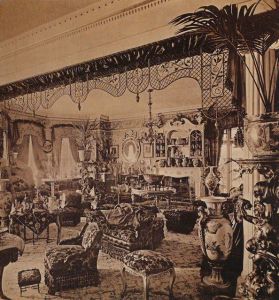
The front parlour or drawing room was the formal room of display, and she would also have a morning room.
Once again, however, this was a society where virtues were on display, but also concealed some dark contradictions. People were conscious that appalling housing in the cities were a very bad look indeed, and they spoke about the need to clear whole areas of verminous and noisome habitations. They were not, however, so attracted by the idea that urban renewal – that is, replacement housing – might be a companion notion. And where the fortunes of many increased during this time, there were also many charlatans who would became obscenely wealthy through shonky schemes that ruined the more credulous investor. Railroads, real or fables, were a favorite ploy.
Interestingly, crinolines – that odd piece of underwear so identified with Victorian women – in themselves say a lot about the times. By 1860, for example, these were now made of hoops of fine steel, and were therefore far lighter and more comfortable to wear than the bent-wood and horsehair versions of a few years before. Thus, you could say, industry had improved the lot of women in general. But that’s not all that can be said about crinolines. Punch, the satirical periodical, had quite a lot to say, in fact. Crinolines enabled skirts to bell-out to some ridiculous dimensions, with which cartoonists had a lot of fun, and, since a crinoline meant that very few petticoats were now needed to create a really impressive width… ladies were very vulnerable to a high wind. Punch loved it.
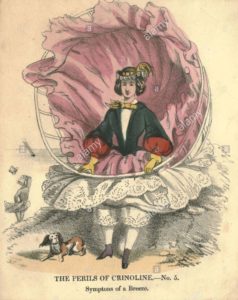
But there’s more. Crinolines meant, as I said, that a fine impression could be made with a much-reduced acreage of petticoats. Yards and yards of dress material advertised the status of the wearer (and her husband and father, perhaps more to the point), but the expense need not extend to the underwear. Victorian dress of 1860 was a bit of a shop-front, indeed. Except for the important point that a certain vulnerability in windy weather encouraged the rapid development of good, solid underwear – drawers and stockings, and so on. In my researches, I was surprised to learn that undies were not so common before the advent of Victorians and their crinolines.
Dress, being such an item of personal display, is a fine subject for those analysing any society. Really, it is. Victorians went through many versions of the dress that not only demonstrated how little a woman was required to do in the way of work (if they weren’t farm workers, servants or factory hands, of course), but that also displayed the status of their husbands or fathers. But, in addition, their dress – especially in 1860 – absolutely demonstrated how confused and contradictory was the prevailing attitude to women. Just look at it: the woman was covered from neck to toe, but her shape was almost grotesquely sexualised.
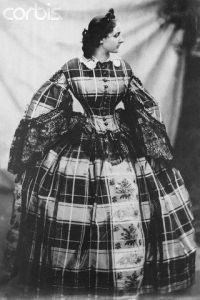
This of course, is where the corset came in, as the companion-piece to the crinoline. (As a little aside, however, the corset in 1860, while it could be tugged very tight, was itself a part of a piece of trompe l’oeil: a good, wide crinoline could help give the impression of an hourglass.)
Not enormously surprising, then, that the bourgeoise in her finery was subject to the politics of the time. This seems a bit unfair, to me, since she and her dress were always in effect lived statements about her husband or her father, really. She herself owned nothing. However, John Ruskin, commentator of the time, was quite caustic about the ostentation implied by extremes of bourgeois female dress; and there arose at this time the Aesthetes and their ‘rational dress’, which did away with both corsetry and crinolines.
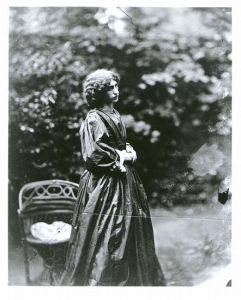
These were political statements in themselves, absolutely, and a sign of revulsion at so much conspicuous consumption. But they were not necessarily a sign that women’s lot in particular was being seen as political – Ruskin was no feminist, and there was a lot of idealisation in artistic circles that really doesn’t suggest women were being seen as anything more that symbols. Just as the nouveau riche, bourgeois class saw them, really.
However, let it also be said that education was reaching women, too, to an unprecedented extent, and that there were some intellectual giants about, who were beginning to speak of the condition of women. John Stuart Mill was one such. Another, if less well-known, was Barbara Bodichon, feminist and member of the Langham Place Circle, which argued for dress reform. She had already written in 1850, after a walking holiday in which she and Mary Howitt opted for practicality and comfort, turfed their corsets and shortened their skirts:
Oh! Isn’t it jolly
To cast away folly
And cut all one’s clothes a peg shorter
(a good many pegs)
And rejoice in one’s legs
Like a free-minded Albion’s daughter.
(Wojtczak, date unknown)
Thus it is clear that in the midst of what was not, to tell the truth, a very liberated space for most women, there were the seeds of a very different set of views altogether. And of course, while not everyone was conscious of taking up anything like a feminist cause, the expansion of the middle classes and the proliferation of journals and literature meant that more women were being heard as writers, and occasionally as commentators. And women were increasingly characters in novels, as well, characters who were active and intelligent. Even children’s literature might sometimes recognise girls. Who could forget Alice in Wonderland or Alice Through the Looking Glass, both of the 1860s?
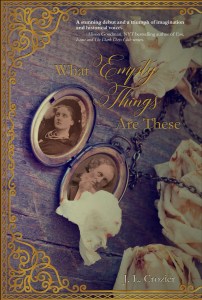 And it struck me, while indulging my fascination for all things Victorian by writing a novel about this most interesting time (remember, 1860 was also the year after Darwin’s theory of evolution crashed onto the scene) that some intriguing questions could be asked. What, I mused, would happen if the patriarch of this most Victorian of households were to lose his hold on it? What if he and his domestic influence were to fade? What would change?
Adelaide encounters many things in my novel, in her search for a life that would have meaning for her once George, her comatose husband, finally passes on. But fundamental to all the changes she goes through are the alterations to the patterns of her own home, including all of the relationships under that roof.
—–00—–
For those interested in pursuing some of the themes mentioned above, my Master’s thesis: Beneath the carapace: virtue versus sexuality, and other contradictions behind meanings imposed on English female shape and clothing in the 1860s is available at my website: www.jlcrozier.com
 JL (Judy) Crozier’s early life was a sweep through war-torn South East Asia: Malaysia’s ‘Emergency’, Burma’s battles with hill tribes, and the war in Vietnam. In Saigon, by nine, Judy had read her way through the British Council Library, including Thackeray and Dickens. Home in Australia, she picked up journalism, politics, blues singing, home renovation, child-rearing, community work, writing and creative writing teaching, proof reading and editing, and her Master of Creative Writing. She now lives in France.
J.L. Crozier’s historical novel, What Empty Things Are These, is available from booksellers all over the world.
 You move into a new house, and of course it’s a hell of a lot of work. We’ve been pulling fourteen-hour days, hauling boxes till our arms and legs ache. And you start setting things up, just so. This goes here—should we put that over there? A seemingly endless number of objects to be placed, to be positioned as the perfect slaves they are, never moving unless we bid them. And you start learning the little peculiarities of the place—the way you have to pull just so to get the shower to work—how the front door sticks a bit. Even the sounds of it, a kind of minor encyclopedia: the kitchen tile you keep stepping on, that makes an odd squelching noise—the way china rattles in the hutch when someone walks past.
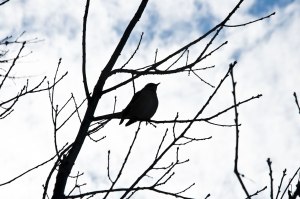 I worried for days, unaware of it, that there were no mockingbirds here. So many in our old neighborhood—and just three miles away! The world alive with them in May and June, their songs filling me whether I listened or not. Then I heard one, here, from the branches of the Modesto ash in our front yard. Fool, I told myself—you just happened to move in early July, the season shifts, they stop singing then. Mates are already won, sex on hidden branches has filled the world with a different, silent kind of song—eggs are growing in feathered bodies, nests being built. They’re here too. Of course.
 In the middle of our big moving day, sweating and dirt-smudged, she and I paused at twilight to glimpse the new crescent through vines and trees in the backyard. Nothing made us feel more at home.
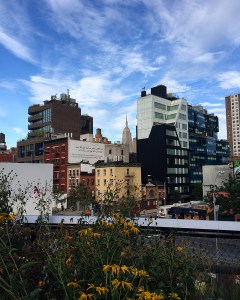 Like so many others, I had moved to New York City with a dream to write, to be at the center of things and pay attention. But such a reality, even in the service of a great dream, is a hard and often lonely one. I knew it wouldn’t be an easy move to make, but I’d be lying if I said it wasn’t harder than I guessed it would be. I was out of my element and struggling to find my place. I knew very few people. To say that I was overwhelmed and scared on a daily basis would be an understatement.
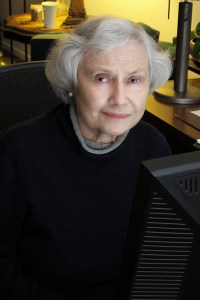 I had an appointment. I was set to interview
  At this point in our conversation, Carol stopped and looked far off. I followed her line of sight. She was looking out the window, at the streams of autumnal light. Whatever she said next would be carefully considered. She took a deep breath.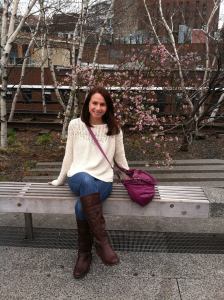

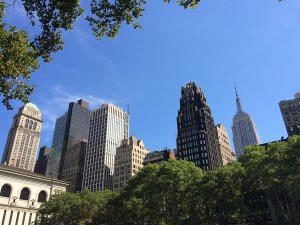 Our conversation shifted to New York City as a place, as an inspirational, larger-than-life refuge for writers and musicians and artists. I asked Carol, as a devoted New Yorker, if she had any advice for visitors of the city. If they only had one day to spend here, what should they do?
 Preferring to write in private was yet another similarity we had. Like Carol, I write best at my desk, looking out at the George Washington Bridge and the Hudson River. Across the river sits New Jersey. The view, the cool breeze, even the sporadic beep-beeps from cars below culminate in an almost dreamlike setting to write. New York City: right outside my window.
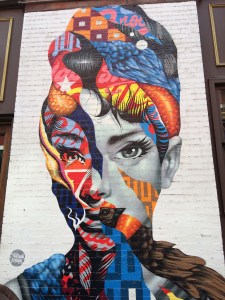 That’s the thing about New York. It’s wild. Every kind of person is represented, walking to some meeting, some friend, some restaurant. It is a place of variety and stimulating diversity, where there is always a million-and-one things to do at any given time. Sit in Washington Square Park and watch the people go by. You won’t see such range anywhere else. And that energy? That New York City energy? That’s there, too. We have energy in spades.
 At this we laughed. I told her that I started writing as an escape. The town I grew up in was small and pretty dull. I needed to lie and tell stories to make things interesting. I shared my theory: all writers are liars. We have to be, to some extent. We have to lie to get to the heart of the matter. We have to stretch boundaries and make impossible things possible to learn how to tell the truth.
 I have always loved reading and creating, with words, with paint and pencils, from joining a Creative Writing class as a child – as an asthmatic and more than a little uncoordinated, team sports were never my forte – to studying art and then writing at university. Since childhood, when I realised that someone had created the book I held in my hand, I have wanted to write. To create. Perhaps it was reading Little Women and wanting so fiercely for Jo to succeed, to be Jo, or alternatively her sisters and enter the Marsh household. Perhaps it was Alice in Wonderland and wanting to throw myself down that rabbit hole. Books were a perfect escape when I was indoors with another bout of bronchitis. They gave me the world. From those tame beginnings to discovering books could not only captivate and inspire me, but thrill me and scare me, keeping me up at night reading under the blankets with a torch. Books introduced me and immersed me in new worlds.
 I was concerned about and for my characters. I needed to ensure that Arthur in particular had moments, however fleeting, when he was ‘human’, and that Ellie, despite her circumstances, not be passive. I found myself going off in tangents in early drafts with minor characters and subplots but judicious readers and editing brought the focus back to Ellie and Arthur, and the confines of restricted world they inhabit.
 Halfway to Tallulah Falls, my son spills his entire bottle of Gatorade into his lap. “Um, Mommmmmay?” He says in a tentative, keening voice, emphasis on the last syllable, the way he always does, adding a frantic edge to what is not really an emergency. “I spilled my drink.” I sigh, tilting back my own water bottle and taking an eager gulp. Thankfully I have leather seats, though we didn’t bring any spare pants and I have no idea how he’s going to hike down a mountain with his butt soaked through.
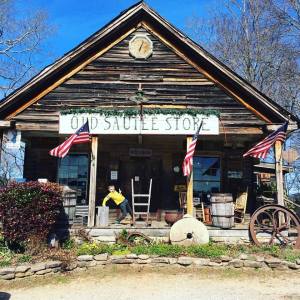 Up the mountain, we stop in the gift shop and buy the kid a pair of leggings and a piece of rock candy in his newest favorite color; cyan. On the way outside, he stops to study a taxidermied fox. We visit the museum exhibit, and I point out the boxcars, the butter churn, the crisp, thin white dresses with their square collars; all relics from a time gone by, with lessons to be gleaned. He nods, but isn’t really paying attention. What use does an eight year old have for sack dresses? He wants to get outside, into the air, to touch the stone and bark, to walk the paths, to hear the delicious crunch of the leaves beneath his feet, and I don’t blame him.
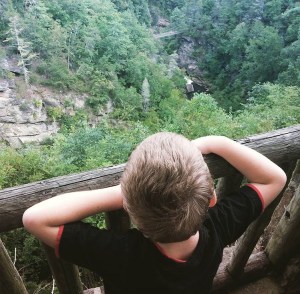 When he was two he wandered off while I was putting his carseat in – I turned and he had vanished. Those ten minutes felt like hours, and when we found him, he was wandering out of the woods – the forests in Oconee County are heady and thick with skinny, gray-brown pine trees, tall and imposing, but full of a gentle kind of calm, as though benevolent ghosts might pass their days there in a cocoon of sweet silence – with our little beagle in tow, humming a little tune as his fat, toddler hands grazed each tree, oblivious and full of joy. He is a natural wanderer, my kid – and while it isn’t always ideal, and are sometimes stressful, these wanderings – I always understand them. I always understand him. In so many ways just like me, but in others so wholly different, so pure and clear-eyed and awake. I feel I know him better than I’ve ever known myself. He is a natural wanderer, fluent in the woods, a real-life tree hugger. He has always felt at home there in the silence of the woods, a place where he is heard and understood, nurtured and adored.
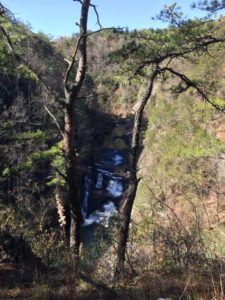 When he graduates high school, I plan to take him on a hike through the Appalachian Trail. I haven’t told him yet, but it’s a secret dream. It seems poignant, appropriate. I can picture him, sweaty blonde hair, cheeks flushed with red in the cool air, panting with exertion, a heavy backpack weighing down wide shoulders. Undoubtedly he’ll have spilled his Gatorade on his pants, or tripped and skinned a knee, but there will be joy.
 When six-foot Curva Peligrosa rides her horse into Weed, Alberta, after a twenty-year trek up the Old North Trail from southern Mexico, she stops its residents in their tracks. A parrot perched on each shoulder, wearing a serape and flat-brimmed black hat, and smiling and flashing her glittering gold tooth, she is unlike anything they have ever seen before. Curva is ready to settle down, but are the inhabitants of Weed ready for her? With an insatiable appetite for life and love, Curva’s infectious energy galvanizes the townspeople. With the greenest of thumbs, she creates a tropical habitat in an arctic clime, and she possesses a wicked trigger finger, her rifle and six-guns never far away.
 Lily Iona MacKenzie is the author of two novels, Fling and

