• Skip to primary navigation
  • Skip to main content
  • Skip to footer

Regal House Publishing

Advancing Finely Crafted Literature

  • Home
  • About Us
    • The Origin Narrative of an Indie Press
    • The Regal Mandate
    • Our Imprints
    • The Regal House Initiative
    • Regal House Publishing Staff
    • Our Professional Affiliations
    • RHP’s Climate Commitment
    • Helen Keller Intl
    • RHP Summer Scholars Program
    • Contact & FAQ
    • Blog
  • Authors
    • Our Authors
      • Regal House Authors & Poets
      • Fitzroy Books Authors & Poets
      • Pact Press Authors & Poets
    • Forthcoming Publications
    • Sour Mash: RHP’s Southern Literature Series
    • Fugere Books: RHP’s Novella Series
    • Regal House Reading Series
    • Author Resources
  • Submissions
  • Marketing & Distribution
    • Our Distribution and Printing Partners
    • Subsidiary Rights
    • For Retailers
    • Events
    • A Conspiracy of Lemurs Podcast
  • Contests
    • The Fugere Book Prize for Finely Crafted Novellas
    • The Petrichor Prize for Finely Crafted Fiction
    • The W.S. Porter Prize for Short Story Collections
    • Past Contests
      • The Kraken Book Prize for Middle-Grade Fiction
      • The Acheven Book Prize for Young Adult Fiction
    • The Terry J. Cox Poetry Award
  • SHOP

About Regal House

To Pants or to Plot? In Defense of a Middle Way

September 25, 2020 Leave a Comment

By Rebecca Baum

I first encountered the terms pantser and plotter on a writing retreat in New Hampshire on Squam Lake. As dusk gathered and the loons wailed, a writer asked which approach I’d used for the middle grade novel I was working on. She went on to define the plotter as the writer who outlines a beginning, middle and end before the first keystroke of the novel itself; and the pantser as the thrill-seeking, fly-by-the-seat type. All they need is a snippet of a scene, glimpse of a character, or flash of setting — and they’re off!

I confessed to being a pantser. My middle grade book emerged in caffeine-fueled bursts, my outflow hindered only by my too-slow fingers. It was my first novel and the process of discovering the story as it was being written was unbridled fun. The downside (as early readers reported) were moments where the story felt rushed or where plot and character motivation didn’t always jibe. Unsurprisingly, that novel was never published. But it was a valuable exercise in showing up every day to slay the dragon of the empty page until eventually I’d hammered out over 60,000 words.

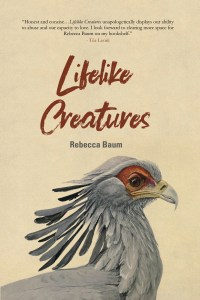
My novel, Lifelike Creatures, started as a pantser affair but morphed into a plotter-pantser hybrid. I started with a visceral sense of the landscape, lifted from my childhood in Cottonport, La. — fresh, turned earth and muddy fields stretching to the horizon, the stultifying heat of high summer, a gray sky both endless and oppressive. Within this rural setting a girl appeared, 13 years old, most comfortable with her toes in the mud. A boy, perhaps a brother, briefly bobbed into view then disappeared, replaced by the girl’s mother. Soon their relationship took shape, a claustrophobic constellation propelled by addiction, resilience, pain, and fierce love. The girl became “Tara” and the mother became “Joan.”
I brought these green shoots into a writing workshop. Each week, as I worked and reworked a chapter, or even a few pages, the contours of Tara and Joan’s relationship solidified. The details of their home came to life as did the intimacies and tensions of their days. The workshop facilitator challenged me to widen the lens and discover a larger community or cultural conflict against which Tara and her mother could struggle and transform — or falter and fail.

He also encouraged me to write a chapter outline, nudging me into the realm of the plotter.  An early outline, which is very different from the final novel, has Tara losing her way in a salt dome mine during a visit to Avery Island (home of Tabasco Pepper Sauce ). Salt domes are massive underground deposits, some as large as Mount Everest, which feature prominently in Louisiana’s geology. I’ve always found them fascinating and mysterious, an interest I share with Tara:

Before fifth grade, when her class had studied salt domes, she’d pictured the New Orleans Superdome made out of salt, buried a few feet below her front yard. But the teacher had explained that the domes were more like underground mountains, formed when an ancient seabed buckled up over millions of years through the surrounding crush of earth. The salt behaved almost like lava, flowing upwards until it capped near the surface. For a time afterwards, whenever Tara salted her food, she imagined tiny flecks of bizarre prehistoric sea creatures mixed in with it.

–Lifelike Creatures, pg. 36

So the impulse to somehow include salt domes in the story emerged early on, even before I’d plotted the larger conflict that would come crashing into Tara and Joan’s world. With salt domes on my radar, it was inevitable that I should happen upon the other geologic phenomenon of Lifelike Creatures, the one that became the larger conflict — a sinkhole. Turns out the two often go hand-in-hand.
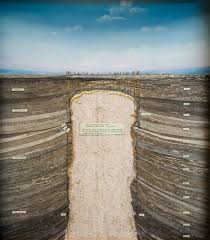
Salt dome cutout, from Louisiana
State Exhibit Museum

Salt domes and sinkholes have made headlines in Louisiana several times over the years, most dramatically at Lake Peignur in 1980, when the drill from an oil rig barge punctured a salt dome beneath the lake. The miscalculation created a sinkhole, triggering an enormous whirlpool that drained the lake and even reversed the flow of a nearby canal, temporarily creating Louisiana’s tallest recorded waterfall.

More recently, the Bayou Corne sinkhole was precipitated by a collapse in the Napoleonville Salt Dome. Or more accurately, the wall of a hollowed out cavern within the dome, near the dome’s outer wall. The cavern was manmade, as are dozens of others nested deep within the dome’s interior. Adding to the mystique of these underground marvels is the fact that they are uniquely well-suited for storing hydrocarbons, natural gas, and even crude oil. If the earth shifts, the salt walls flex and flow. Integrity is maintained as long as the surrounding salt is of adequate thickness. It was not in the case of the Bayou Corne sinkhole. As a result, an entire community was displaced with many residents leaving behind what they’d assumed would be the golden years of retirement.
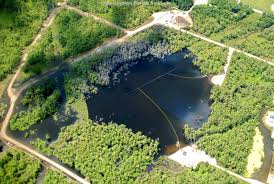
The Bayou Corne sinkhole

The sinkhole in Lifelike Creatures is modeled on this real-life industrial disaster. My fictionalized version not only connects the “small” story of Tara and Joan with larger, catalytic forces. It also mirrors the downward spiral of drug and alcohol addiction and the corrosive effects on the parent-child relationship. I’m fortunate to have a close friend who is a geologist. He generously shared his expertise, allowing me to plausibly plot sinkhole and remediation events that force Tara and Joan into “adapt or die” situations.

So pantser or plotter? Based on my experience with Lifelike Creatures, I’ve embraced a middle way. The tools of the plotter kept me grounded even as the chapter outline changed and evolved. The pantser’s spontaneity offered unforeseen gifts, including a pivotal moment that totally took me by surprise. Early readers have had no qualms about pacing or character motivation. And Tara and Joan were given what every character deserves — a plot integrated with their core desires and beliefs.

Rebecca Baum is a New York City transplant from rural Louisiana. She’s authored several short stories and two novels. The most recent, Lifelike Creatures, was published by Regal House Publishing on September 17, 2020. She is represented by Jeff Ourvan at Jennifer Lyons Literary Agency. She’s a cofounder of a creative studio where she is a ghostwriter, copywriter, and blogger. She lives in Greenwich Village with her husband and their cat.

Filed Under: Literary Musings, Regal Authors Tagged With: Lifelike Creatures, Rebecca Baum, writing craft

Rebecca Baggett:

May 26, 2020 1 Comment

The Nostalgia for Things Lost & A Tenderness for the World in Which We Find Ourselves

Winner of the 2020 Terry J. Cox Poetry Award

Rebecca Baggett

In December of 2019, I retired from the University of Georgia after over thirty years as an academic advisor.  In that time, I worked at three different universities, sometimes advising students in pre-professional programs, but primarily with liberal arts majors in UGA’s Franklin College of Arts and Sciences—students studying languages, literature, theatre and film, religion, anthropology, women’s studies, history, resulting in conversations that animated and enriched my life and my writing.  My last months were spent in hours of discussion with students and colleagues and concluded with a farewell gathering that included former and current colleagues, administrators, and a variety of faculty across the departments for which I advised. 

I retreated to my “book fort” for the winter, almost literally hibernating with a stack of novels and poetry collections, and emerged only occasionally to poke a pen around a legal pad or go online to submit individual poems and my full-length manuscript.  As an introvert in recovery from years of professional talking, I gave myself full license to sleep, read, nap, read, and catch up on a few Netflix series. 

I began to wake as spring and Covid-19 arrived in Georgia and by mid-March found myself in full-on isolation with my husband, a retired high school teacher.  Our church shifted from in-person to Zoom to YouTube, as our bishop (wisely) tightened restrictions on gatherings, weeks earlier than Georgia’s governor.  Our city closed down large gatherings, then schools, bars, restaurants, again, long before the state at large. My book group and poetry group, “dinner women” and former colleagues withdrew to our homes, and our only “in real life” contact was with our pregnant daughter and her husband, who also isolated as much as possible.  Soon after our grandson’s St. Patrick’s Day birth, our son-in-law had to return to work, so we spent weeks helping our daughter with our newborn grandson.  It was both a mercy and a gift to immerse ourselves in the immediacy of an infant’s needs and to know that between us we could provide Christopher everything he needed – food, clean diapers, the occasional bath, constant human contact, the sound of our voices, our adoration. 

Like all of us, I felt no such calm when I looked into the larger world and tried as much as possible not to imagine what horrors might loom, what this pandemic could mean for people I love and for so much of what I value in our world.  I didn’t think often about my manuscript, circling through the round of competitions, or whether it would ever be published.  When I did remember, I assumed the slim chance of publication had probably shrunk to next-to-none.

What a joyful shock to receive Jaynie’s email telling me that The Woman Who Lives Without Money had won the Terry J. Cox Poetry Award.   What a gift to receive that news at a point when I could easily imagine no publisher having the courage or the financial foundation to continue to print books.  And it is an equal gift to realize that Regal House Publishing shares my conviction that a life in the arts is, in some sense, a life of companionship and service.  Like every writer I have ever known, I struggle with the tension between creation — a focus on the work itself — and the pull toward publication – sometimes warring impulses. The reality is that only a fraction of artistic work will ever receive recognition, that few of us – whatever our medium – will be able to live on an income from our art alone, that many far more talented writers than I will give up, ground under by the necessity of earning a living, by despair, by lack of an audience, by inability to live in uncertainty.  Which is, of course, where we all live now.

In this unfolding world, perhaps we will learn that what seems most ephemeral (poems, stories, music, dance, theatre) and most fragile (the shell of my grandson’s skull beneath my cupped hand, the bloodroot petals unfolding in my spring garden, our ability to shelter those we love from harm, our desire to shelter those we do not know at all) are the essence of what it means to be human.  I believe that in this moment there is nothing more worth doing than creating art and midwifing it into the world.  I hope that readers find in The Woman Who Lives Without Money not only a nostalgia for things lost but tenderness for the world in which we live now and for whatever is coming next.

Rebecca Bagget is the author of poems, essays, and stories, published in numerous journals and anthologies, as well as four chapbooks, two of which (God Puts on the Body of a Deer, from Main Street Rag, and Thalassa, from Finishing Line Press) remain in print.  She is a retired academic advisor from the University of Georgia and she has been a Fellow at the Virginia Center for the Creative Arts.

Filed Under: Regal Authors Tagged With: Rebecca Baggett, Terry J. Cox Poetry Award winner

Steven Mayfield: “It’s Hard to Make Up Stuff that Good”

April 1, 2020 1 Comment

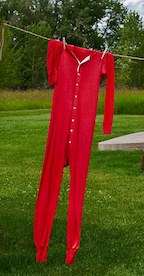
Writers are always advised to write what they know. I don’t disagree, but think that it’s how you come to know about something that matters. I once took a class from Roger Welsch, the renowned folklorist. He advised us not sell ourselves short on what we knew, recalling a previous student flummoxed by her lack of worldly experiences upon which to draw. Dr. Welsch gave her an assignment. “Think of something about your family that you find interesting.” The girl came back with the following tale: Her grandmother and grandfather lived in a small Nebraska town where everyone knew each other. It was in a time when people talked over the back fence and hung their laundry on a clothesline. Every week the girl’s grandmother washed her husband’s pajamas and hung them on the line. When they were dry, she neatly folded them and placed the PJs in a dresser drawer where they remained until the next week when she removed the clean, unworn pajamas, rewashed them, and again hung them on the line. Why did she do this?

“Well,” the girl told Dr. Welsch, “my grandpa slept in the nude and my grandma didn’t want anyone to know.”

“It’s hard to make up stuff that good,” Dr. Welsch told his student.

So, she did have something to write about, even though it wasn’t drawn from her own experience. She’s not alone. Frank Herbert created the world of Dune, J.R.R. Tolkien the inhabitants of Middle-Earth, J.K Rowling the wizard’s school at Hogwarts. My next book, Treasure of the Blue Whale, describes a town and a time period that I never knew. Don’t blame me for such presumptuousness. Blame Alastair MacClean. When I was a teenager, I loved books by MacClean, the Scottish schoolteacher who wrote The Guns of Navarone and other adventures. His tales of mountain-climbing commandos, nuclear submarines, and double agents were concocted without actual experiences. He did not learn about such people and things by scaling Matterhorn, doing battle with Blofeld, or splitting an atom. He went to the library. Afterward, he didn’t write what he knew; he knew what he wrote.

The Golden Gate Bridge in San Francisco, CA at sunset.

A few years ago, when I lived in San Francisco, I picked up my wife from an appointment in Pac Heights. When I pulled up to the curb, she was waiting alongside a very old man. “This is Zane,” she told me. “We’re giving him a ride.”

Zane got in the car and introduced himself. “Thank you for your kindness,” he said. “In exchange, you will get a really good story.”

Zane was 90 years old and Nisei—born in America—the son of a Scotch-Irish mother and a father who was Issei—born in Japan. He’d gone to high school in San Francisco, graduating in 1942 just a few months following the attack on Pearl Harbor. Not long thereafter, Zane and his parents were shipped off to an internment camp in Utah. He spent a year there before being allowed to enlist in the Army.

“I moved to New York City after the war,” he told us. “I lived there for twenty-six years. I was a dance instructor.” He offered to give my wife and I free lessons. He said the rumba was easiest and we’d start there.

Zane’s home was in an assisted living facility not far from the Golden Gate Bridge. The sidewalk fronting the building was steep and we offered to help him to the door. “I can make it,” he assured us. “Have you heard of Michael Jackson? He did the moon walk. I can do the moon walk, too.”

And then he did.

“He was interesting,” I said to my wife as we drove home. I was already planning the book I would write, one currently in progress.

“Yes he was,” she replied, “he was very sweet. And his story…can you believe it? Why, you just can’t make up stuff that good.”

Steven is the past recipient of the Mari Sandoz Prize for Fiction and the author of over fifty scientific and literary publications that have appeared in Event, The Black River Review, cold-drill, artisan, The Long Story, and the anthology From Eulogy to Joy. In 1998, he was the guest editor for Cabin Fever, the literary journal of the Cabin Literary Center. He is the author of Howling at the Moon, a Best Books of 2010 selection by USA Book News as well as an Eddie Hoffer Finalist.

Filed Under: Literary Musings, Regal Authors, Regal House Titles Tagged With: Steven Mayfield, Treasure of the Blue Whale

Karol Hoeffner: The Book Cover Reveal

March 23, 2020 Leave a Comment

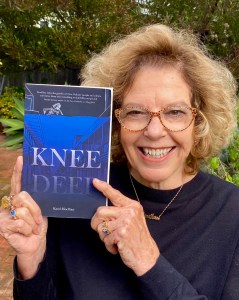
Early on a bright January morning, I opened my computer to an email from my Regal House editor announcing that the interior and exterior proofs of my book were attached and ready for viewing.  Getting a book published is a little like giving birth. And seeing the cover is like holding your baby in your own arms for the very first time.

In other words, it’s a really big deal.

I peered at the tiny pdf attachment of my book cover, which was literally no bigger than my thumbnail.  All I could tell from the image on my phone, was that the cover was very, very blue.

And I was shocked.

My book had a blue cover.

I think I literally recoiled.  How could this have happened?  How could the artist paint my book cover blue?  Okay, water is involved in the story. Lots of water. Knee Deep takes place in New Orleans, which is literally surrounded by water: Lake Pontchartrain to the north, Lake Borgne to the east, wetlands to the east and west, and the Mississippi River to the south.

That was not the problem. 

The problem was I am not a blue person.

There are no blue rooms in my house.

No blue dresses in my closet.

And really, there is no blue food in my fridge, except for blueberries and one could argue their blueness borders on blackish purple.

And yet there it was.  A book with a decidedly blue color.

I rushed up the stairs to my daughter’s bedroom.  I wanted to open up the pdf and see the cover with her, not only because she has been a cheerleader for Knee Deep from its beginning, but because she was in the house and my husband had already gone to work. Having recently moved home to finish her master’s degree while working full-time and already sleep-deprived, she was cocooned in her blanket, sleeping like a baby.  A really good mother would let her sleep in a little longer.

Instead, I climbed into the bed beside her and woke her up. 

And together,  we opened up the pdf to a full screen.

And yes, the cover was blue.  There was no mistake about that.

And yet…

…I fell immediately in love.

With my cover.

When I saw the image of Camille reaching out across the waters I knew instinctively what my friend, fellow screenwriter and Regal House author, Mary Kuryla would later say: “It’s an alarming image because of the rising water pushing at the title, and her little tender boat, but it’s also darkly beautiful. She does not seem in peril in the image, but rather charged with coping with these rising waters.”

I may not be a blue person.

But I do have a blue metal roof on my home that ripples like ocean waves.

And my front yard is an overgrown oasis of blue flowers sprinkled amidst the rambling white roses.

While I do not own a blue dress, I have been known to buy a blue blouse or two.

And I do eat blueberries for breakfast almost every single morning.

And now I have a blue book.

Which I cannot wait for you to see.

And to read. Pre-orders are available now.

Acknowledgement:  The cover for Knee Deep was designed by the immensely talented C.B. Royal  who also designed a number of Regal’s other covers as well – such as Banana Republic, Ms. Ming’s Guide to Civilization, Grape!, Zip, or Micrology.

Karol Hoeffner is the Chair of Screenwriting at Loyola Marymount University in Los Angeles. She has fourteen film credits including several Danielle Steel adaptations, a television mini-series Harem, movies-of-the-week based on true stories – TheMaking of a Hollywood Madam and Miss America:  Behind the Crown. Among her other credits are the original movies, Voices from Within and Burning Rage. She has penned two young adult novels, All You’ve Got, and Surf Ed.

Filed Under: Fitzroy Books Titles, Regal Authors Tagged With: Karol Hoeffner, Knee Deep, YA fiction

Ill-Fated Lovers: Writing About Socioeconomics and Race

March 2, 2020 3 Comments

Writing Bliss presented several challenges which I would divide into two categories: the literary and the personal.

Portraying the impediments to Danielle and Connor’s relationship—the central plot of Bliss—was challenging primarily because those impediments are societal, as opposed to interpersonal or circumstantial. It would be one thing if they were merely too stubborn or prideful to admit their feelings, if they only misunderstood each other (which, for much of the novel, they do), or if they were from rival families, he a Montague, she a Capulet. But it is their socioeconomic and racial differences that threaten the love between them, and capturing the implications of these differences was thorny. Societal constructs are both omnipresent, all-powerful and insidious, and rarely discussed in everyday life, much less between two individuals from completely different backgrounds, like Danielle and Connor.

Connor, raised amid affluence and ease in a predominantly white community, has never reflected much on the luxuries of his race, which are apparent to Danielle, raised amid poverty and strife in a predominantly black community. More, she cannot comprehend why someone would forgo the opportunities wealth has offered him, as Connor attempts to do in the beginning of the novel. A rec center employee devoted to the needs of underserved children, she knows that luxury and opportunity are rare and precious blessings, and falling in love with someone who doesn’t understand this feels to her like a betrayal of her community. They are each caught between two worlds—their own and their lover’s—worlds their love can reveal but perhaps never reconcile. Perhaps.

Bliss also presented a personal challenge, because years of examining these characters’ worldviews had a powerful, if disquieting, effect on my own. I am the child of middle class parents who fostered roughly seventy kids. I attended public high school in northern Minnesota, then private college at St. John’s University (MN). I grew up believing I was capable of grasping a wide array of viewpoints. So, when I conceived of the basic premise behind Bliss back in 2014, at the tail end of a brief correctional career in Saint Paul, Minnesota, I felt that my experience—in particular, the year and a half I spent as a guard at the Ramsey County Juvenile Detention Center—offered me unique insights into urban poverty and relations between law enforcement and communities of color. However, the more I explored Danielle and Connor’s lives and the more confident I was in their motives and natures, the more I asked the obvious question: What right do I, a white man in 2020 America, have to write a love story featuring a black woman?

To this I have no answer. I can only take solace in the equally obvious fact that I am no authority, not on America, its merits or ills, not on race, womanhood, or love; rather, my time with Bliss has further convinced me that the realm of fiction is not for authorities. It is for the uncertain, those with more questions than answers, those who wish to understand the things they know they never will.

Fredrick Soukup received a philosophy degree from St. John’s University (Minnesota) in 2010. Excerpts from his works have been published in Fluent Magazine and Sou’wester. His debut novel, Bliss, will be released March 2, 2020 by Regal House Publishing. He lives in Saint Paul with his brilliant wife, Ashley.

Filed Under: Literary Musings, Regal Authors, Regal House Titles Tagged With: Bliss, Fredrick Soukup

The Magic of Place

February 13, 2020 Leave a Comment

by Heather Newton, finalist of the 2019 W.S. Porter Prize for McMullen Circle

Every work of fiction starts with a question, and often that question is “what if?”

I grew up in Raleigh, spent time in Pittsburgh and Boston, but have lived in Asheville since 1992. Western North Carolina is the first place that ever truly felt like home. When I drive I-40 West after visiting my family in Raleigh and round that one bend where the mountains come into view, my heart leaps up. 

I bookended my McMullen Circle story collection with two short pieces from the point of view of a mountain. The “what if” of those pieces is what if the places we love love us back? What if, when my car rounds that bend on I-40, the mountain sees me and its heart leaps up?

Humans’ attachment to place is a mysterious thing. There’s no predicting what locale will take hold in a person’s heart. It might be where we came from, where we fled to, or a town or city or country that we stumbled upon on our way to somewhere else. Maybe a place where light hits water in a way that makes us ache. Maybe where we experienced comfort from people who loved us, or discovered who we were, or briefly became our best selves.

As a writer, I find that no matter what story I want to tell, I need to set it in a place I love (even if my characters don’t love it). I have to know what plants bloom in what season, how the locals speak, the color of the dirt. Sometimes that place exists only in memory, and the very act of remembering changes it.

McMullen Circle is set in North Georgia, an area I have come to love because my husband loves it. There, like Asheville, the Appalachian Mountains lift my mood and calm my stress. I am deeply grateful to Regal House Publishing for creating a home for these stories so that I can share them with you.

The mountain feels them walking on its surface. Their feet are part of its wearing down. Feet and wind and freeze and thaw and streams that carry its dust to the sea.

What place has your heart? 

Heather’s short story collection McMullen Circle was a finalist for RHP’s 2019 W.S. Porter Prize. Her novel Under The Mercy Trees (HarperCollins 2011) won the Thomas Wolfe Memorial Literary Award, was chosen by the Women’s National Book Association as a Great Group Reads Selection and by the Southern Independent Bookstore Alliance as an Okra Pick (“great southern fiction fresh off the vine”), and was long-listed for the 2012 SIBA Book Award and the American Library Association’s Over The Rainbow project. Her short prose has appeared in Enchanted Conversation Magazine, The Drum, Dirty Spoon and elsewhere.

Filed Under: Literary Musings, Regal Authors Tagged With: 2019 W.S. Porter Prize finalist, Heather Newton, McMullen Circle, short story collection

How I Lost a Girlfriend in a Cave and Learned to Mine Empathy

February 13, 2020 Leave a Comment

by Dan Kopcow, author of Worst. Date. Ever

Worst. Date. Ever. is a fiction short story collection about romantic dates gone horribly wrong.  As I sifted through my short stories to see which ones fit into this collection, it occurred to me that the narrator or main character in some of these stories was not always the one going through their worst date ever.   It reminded me that, as a writer, it’s good to let the reader figure out whom to empathize with.   

We immediately think of ourselves experiencing the worst date ever.  But keep in mind that there were times when we went on a date and caused someone else to have the worst date ever.  There were times in our life when we thought the date went fine but the other person never saw us again.  Perhaps, and unbeknownst to us, they may have had the worst date ever.  And we might have been the cause!

Many years ago, I was dating this woman and we decided to go on vacation together.  It was a tremendous test of our relationship.  For the first time, we would be spending every minute together, observing how we behaved in new situations, bathroom habits, the whole caboodle.  We  traveled to Montana and were having a wonderful time.  Then, we went to Jewel Cave National Monument.  

Jewel Cave

I don’t know if you’ve been but the trip involves driving for hours through prairies, with the mountains glaring down and judging you.  You arrive at a National Park office where you take an elevator about a mile straight down into the earth.  When the elevator doors open, the temperature has dropped and you are immediately aware of humidity and the fact that you are in another world.  A tour guide takes you through a roped-off path through some truly spectacular and colorful caves.  

When my date and I arrived back up to the surface, her coldness toward me matched the Jewel Cave temperature.  For the rest of the trip, she couldn’t wait to go home.  I never heard from her again.  And I couldn’t figure out what went wrong.  

A section of The Miseries

At the time of our trip, we were both in our thirties and she had been very clear that she was interested in having children.  In hindsight, after sifting through details, I pinned down the moment when things fell apart.  It happened a mile below the surface.  While on our family tour in Jewel Cave, we came to the end of our path, marked by some Do Not Enter signs.  Our tour guide told us this was as far as we could go.  We’d have to turn around and walk back the way we came.  The tour guide went on to explain that on the other side of the Do Not Enter signs was The Miseries.  The Miseries are a series of extremely narrow cave openings that only the most dedicated and experienced cave explorers dare to enter.  The openings are twelve to sixteen inches wide by two to three feet long.  You stuff yourself into this opening and slowly, painfully, shimmy your way through, sometimes a few inches an hour.  This goes on for some time while you get bruised and scraped in complete darkness.  For fun, The Miseries alters its claustrophobic openings from a vertical to a horizontal orientation.  It takes about half a day to get through The Miseries.  When you finally arrive through the other side, bloody and exhausted, you witness an enormous and glorious cave.  You camp out there overnight, aided by the camping equipment you have been dragging in a bag which has been tied to your ankle the entire time.  The next morning, you do the whole thing in reverse.

Worst. Date. Ever.

When the tour guide completed The Miseries description, I joked out loud, “Why don’t we send the children through there with cameras so they can show us what it looks like?”  The families held their kids close to them as if I were a serial killer.  My girlfriend, realizing I might not be ideal father material, was suddenly having the Worst. Date. Ever.

I think about that story as a writer and how, depending on whose perspective you’re following,  your empathy shifts and the story’s tone changes from comedy to horror.  My hope is that these stories entertain but also remind us to be more empathetic.  And to keep your mouth shut when you’re trapped a mile underground with strangers.

Dan’s stories have appeared in dozens of literary magazines nationally and internationally.  His short story, “Brain Takes a Sick Day,” was selected for inclusion in the Satirica anthology. His short story, “The Cobbler Cherry,” was included in the anthology, Thank You, Death Robot, which won an Independent Publishing Award for Best Science-Fiction and Fantasy and was named a Top Ten Fiction Novel by the Chicago Tribune.  He is currently at work on three novels.

Filed Under: Literary Musings, Regal Authors Tagged With: Dan Kopcow, short story collection, Worst. Date. Ever.

The Evolving Narrative Theme: Swimming Pool Stories

December 9, 2019 Leave a Comment

by Louise Marburg, winner of the 2019 W.S. Porter Prize for No Diving

When I began to write the stories that became the collection No Diving Allowed, I wrote as I always write, one story at a time, with no sense of working toward a theme or an audience or an eventual book. Chronologically, the first story I wrote was “The Bottom of the Deep End,” in which a swimming pool is so central it’s practically a character; the second was “Creamer’s House,” in which the swimming pool described was at first merely a feature of the house, then in rewrites gained greater significance. The next story,” Talk to Me,” is set at a beach resort, yet there, too, is a swimming pool, one that the protagonist longs to swim in but is thwarted in that wish — and in others — by her new husband. I don’t think I realized until “Talk to Me” that I had written three stories in a row that contained a swimming pool. Once I saw what I had done, I simply continued writing stories with the idea that a swimming pool might or might not appear, but if one did, I would consider that story a sibling of the other three. Yet, funnily enough, most of the stories I wrote did end up having swimming pools in them, and over the course of about three years what I thought of as “the swimming pool stories” grew very naturally. Never did I have to conjure a way to insert a pool, nor did I begin a story thinking about devising a plot around a pool.

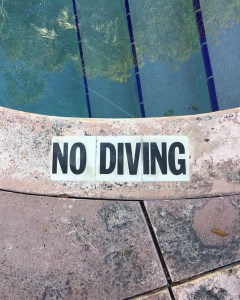
A couple of years ago, I was talking to the late great short story author Lee K. Abbott at the Kenyon Writer’s Workshops. I described what was going on with this growing pile of stories, and he said, “I know what the title of the collection should be! No Diving Allowed!” Lee Abbott was masterful at creating titles, and I thought that was a great one, precisely apropos, but story collections are usually titled after a story within the collection, and I had not written, nor did I expect to write, a story called “No Diving Allowed.” Then a few months later, as I was writing a story in which a very fat man cannonballs into a country club pool, a lifeguard suddenly appeared out of nowhere screaming, “No diving allowed!” I sat back in astonishment. There was the title story of the collection. I wrote several more stories after that, but the title No Diving Allowed continued to seem as perfectly on point as when it was suggested by Lee.

Louise Marburg is the author of a previous collection of stories, The Truth About Me (WTAW Press, 2017), which was named by the San Francisco Chronicle and Entropy as a best book of 2017, won the Independent Publishers Book Awards Gold Medal for short story collections, and was shortlisted for the Saroyan Prize. Her work has appeared in such publications as Narrative, The Pinch, Carolina Quarterly, Ploughshares, and many others.

Filed Under: Regal Authors Tagged With: Louise Marburg, No Diving Allowed, W.S. Porter Prize winner

  • « Go to Previous Page
  • Page 1
  • Page 2
  • Page 3
  • Page 4
  • Go to Next Page »

Footer

The Regal House Enterprise

Regal House Publishing is the parent company to the following imprints:

Fitzroy Books publishing finely crafted MG, YA and NA fiction.

Pact Press publishing finely crafted anthologies and full-length works that focus upon issues such as diversity, immigration, racism and discrimination.

The Regal House Initiative, a 501(c)(3) nonprofit that conducts project-based literacy and educational outreach in support of underserved communities.

From our Blog

Dockside Books: An Up North Haven for Thinkers, Adventurers, and Creatives

Tombolo Books: a book lover’s loveshack in downtown St. Pete, Florida

That’s My Story: Regal House Publishing (RHP) Interviews Novelist James Janko

  • Facebook
  • Twitter
  • LinkedIn
  • Google +
  • Email
Regal House Publishing · © 2017–2025 · Website design by Lafayette & Greene
 

Loading Comments...