• Skip to primary navigation
  • Skip to main content
  • Skip to footer

Regal House Publishing

Advancing Finely Crafted Literature

  • Home
  • About Us
    • The Origin Narrative of an Indie Press
    • The Regal Mandate
    • Our Imprints
    • The Regal House Initiative
    • Regal House Publishing Staff
    • Our Professional Affiliations
    • RHP’s Climate Commitment
    • Helen Keller Intl
    • RHP Summer Scholars Program
    • Contact & FAQ
    • Blog
  • Authors
    • Our Authors
      • Regal House Authors & Poets
      • Fitzroy Books Authors & Poets
      • Pact Press Authors & Poets
    • Forthcoming Publications
    • Sour Mash: RHP’s Southern Literature Series
    • Fugere Books: RHP’s Novella Series
    • Regal House Reading Series
    • Author Resources
  • Submissions
  • Marketing & Distribution
    • Our Distribution and Printing Partners
    • Subsidiary Rights
    • For Retailers
    • Events
    • A Conspiracy of Lemurs Podcast
  • Contests
    • The Fugere Book Prize for Finely Crafted Novellas
    • The Petrichor Prize for Finely Crafted Fiction
    • The W.S. Porter Prize for Short Story Collections
    • Past Contests
      • The Kraken Book Prize for Middle-Grade Fiction
      • The Acheven Book Prize for Young Adult Fiction
    • The Terry J. Cox Poetry Award
  • SHOP

Blog

Dockside Books: An Up North Haven for Thinkers, Adventurers, and Creatives

December 2, 2025 Leave a Comment

By Linda K. Sienkiewicz

I brake for bookstores. Literally. So when my husband and I were driving through Charlevoix in northern Michigan, hunting for fall color, and I spotted Dockside Books tucked among the town’s boutique shops, I knew I had to stop.
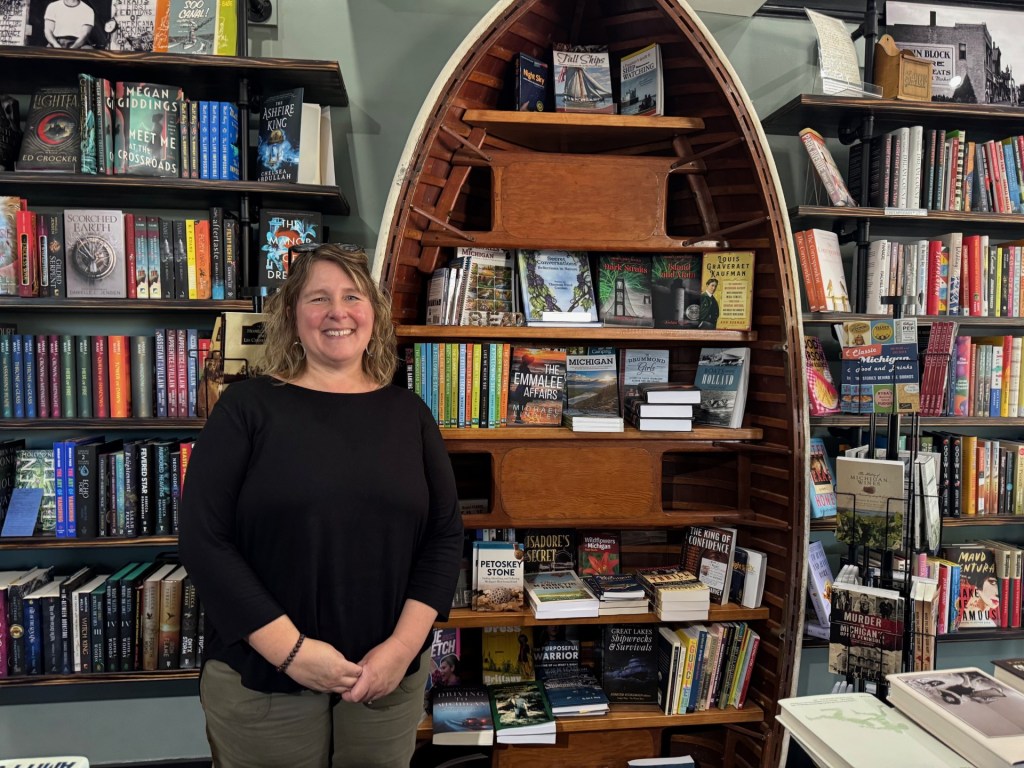
Before I stepped inside, I was greeted by the owner, laughing, as she tried to sweep fallen leaves away from the open door. That friendly warmth carried through as I browsed her gorgeous shop and chatted with her.

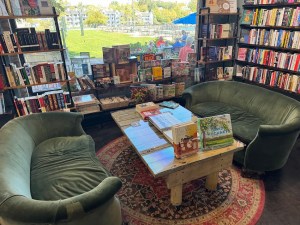
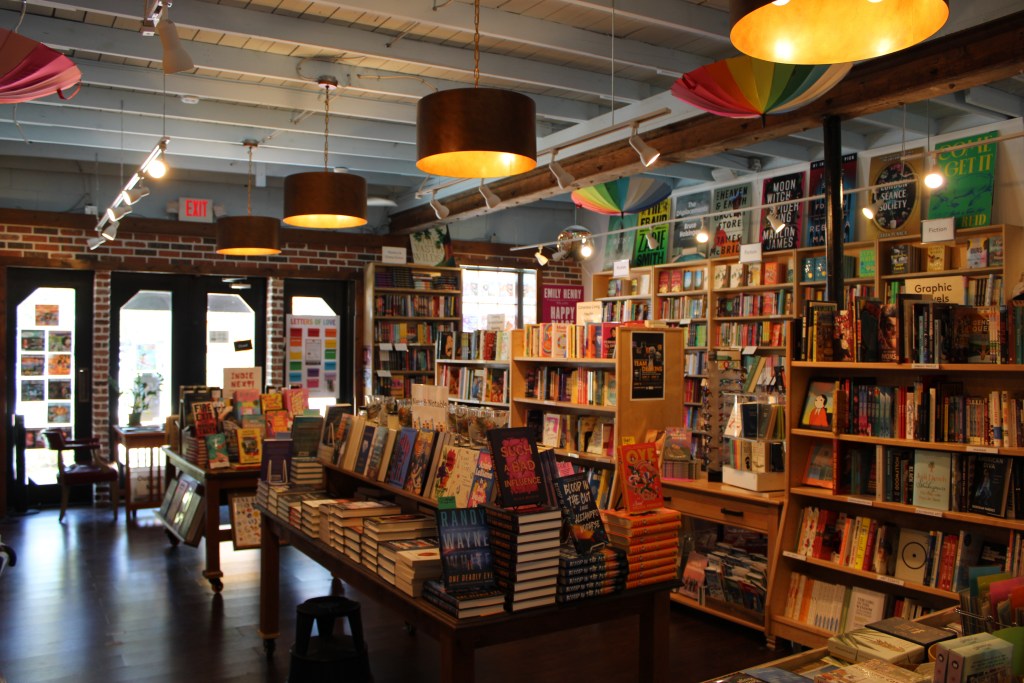
The bookshop feels like a 1920s parlor designed for lingering. A soda-fountain table and chairs sit in the bay window overlooking Main Street. Two green velvet couches face the large arched window with views of the bridge and harbor. Old leather chairs nestle in a back corner, and the children’s room features seats crafted from dock pilings. Every nook invites you to stay awhile.
Shoppers can sip complimentary coffee while browsing books, art supplies, vinyl records, magazines, and creative odds and ends. “Great books, like great music or art of any medium, have the ability to change our hearts and weave themselves into the fabric of who we are,” owner Julie Bergmann told me. “They make us better humans.”

I think I swooned.

What surprised me most was learning that owning a bookstore had never been part of Julie’s plan. She was finishing her Ph.D. in educational leadership when she heard the town’s only bookstore was closing. Julie’s roots run five generations deep in Charlevoix, and the loss of a bookstore felt personal. The community had given so much to her and her husband over the years, and they began wondering… What if?

A succession of serendipitous events followed that she likens to Santiago’s journey in The Alchemist, where the shepherd boy is searching for hidden treasure only to find something entirely different than the one he was seeking. Julie was retiring from a career in education, her children were grown, and she and her husband had been discussing the importance of a thriving downtown that attracts and supports young professionals and creatives.
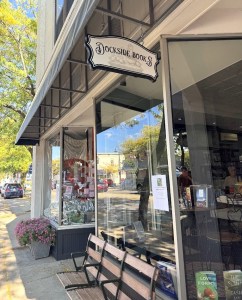
And then the perfect space opened in a 1917 building with an original tin ceiling, rich trim, and an enormous brick-lined arched window overlooking the drawbridge, harbor, and park. “Almost instantly,” Julie said, “I could see people enjoying books and coffee on couches in front of that window and tall, cigar-stained bookshelves along the walls. We signed on the line in a hurry.”

Even the shop’s name carries a lovely history. Dockside Books pays homage to the late Bill Ratigan, a beloved Charlevoix local and steamboat captain turned journalist and novelist. Ratigan operated a small used bookstore in a fish shanty called The Dockside Press from the fifties through the Seventies. In the seventies and eighties, Dockside Pharmacy was serving middle and high school students phosphates and milkshakes at its soda fountain counter during open-campus lunch.

Ratigan’s family was honored when Julie and her husband approached them about using the Dockside name. Today, glossy black-and-white photos of both the press and the pharmacy hang on the walls of Dockside Books. The bookstore sits directly in front of Bridge St. Tap Room, and Julie keeps the back door open so patrons can wander freely from “books to beer,” creating an easy neighborhood camaraderie.
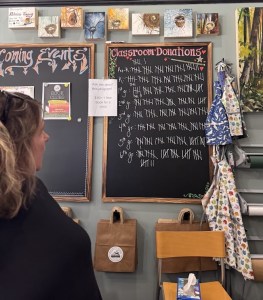
Inside the shop, a chalkboard behind the register caught my eye: Classroom Donations, with grade levels and tally marks. A sign beside it read: Ask me about this program! $10 = 1 free book for a child.

As a former teacher and school administrator, Julie is especially passionate about getting books into children’s hands. She works with the local school district to supply low-cost books, but she knows that during school book fairs, some students quietly stand aside because their families can’t afford to purchase a book.

“I wanted every child to have the experience of coming to the bookstore and picking out any book they like, for free,” Julie said. She put up the colorful $10 chalkboard, hoping the community might respond. They set a goal to support every Pre-K through 6th grade classroom and ended up raising enough for more than 350 donated books.
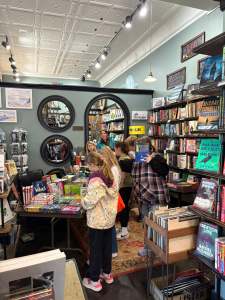
“The gratitude we have for every person who donates is beyond measure,” Julie said. “I wish they could see the expressions on the children’s faces. They simply cannot believe that someone who doesn’t even know them cared that much. This is just another way that independent bookstores are unique—giving back to their local community in ways that make an immediate impact.”

Her customer-centered approach delighted me. Independent booksellers have a better “algorithm” than anything online. Tell them what you love, or what you’re in the mood for, and they’ll hand you something startlingly perfect because they actually know the books. Julie did exactly that for me. Dockside also carries limited editions, signed copies, and special titles you won’t find at chain stores.

Though Dockside Books has been open only six months, the numbers are astonishing. “We’re a 1,200-square-foot store,” Julie said, “and we’ve already put over 11,000 books in customers’ hands. We’re incredibly grateful for the support and warm welcome.”

With their “eyes and nose finally above water,” Julie and her husband are now focusing on building Dockside into a true gathering space—a hub for author events, dialogue, ideas, and creativity. Early events like mahjong classes, author signings, and book clubs have already been a hit.

For Julie, the best part is the daily reminder of how deeply books matter to people. That’s what fuels Dockside Books: reaching out, extending their best selves, and listening to every person who walks through the door.

Find Dockside Books: 204 Bridge St., Charlevoix, MI, United States

Michigan Website: Dockside Books Bookshop

Follow them on Facebook

Linda K. Sienkiewicz is a poet and author whose work has appeared in numerous journals and anthologies. Her debut novel, In the Context of Love, was a finalist for multiple awards including the Hoffer Award and Sarton Women’s Fiction Award. She has five poetry chapbooks and a children’s picture book. Her novel Love and Other Incurable Ailments is forthcoming from Regal House October 27, 2026. Linda volunteers at Neighborhood House, a local nonprofit in Michigan.
Filed Under: Book Bound Tagged With: BookBound, Dockside Books, Linda K. Sienkiewicz

Tombolo Books: a book lover’s loveshack in downtown St. Pete, Florida

October 8, 2025 Leave a Comment

by John Fleming

For the record, a tombolo is a sandy isthmus that links an island to the mainland, and if we are all “islands shouting lies to each other across seas of misunderstandings,” as Rudyard Kipling wrote, then Tombolo Books in St. Petersburg is the antidote for both our isolation and our lies.

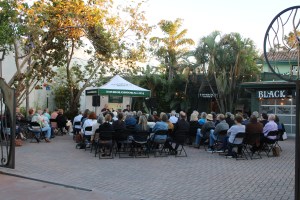
Sandwiched between Black Crow Coffee and the St. Pete Opera Company’s “Opera Central” with a SunRunner transit stop directly in front, Tombolo is a book lover’s loveshack in downtown St. Pete. If you’re not arriving by bus, skip the 1st Street entrance and enter through the lush courtyard next to the “Love Your Neighborhood” mural on (no joke) Poetry Alley. You’ll be greeted by the caffeinated breeze of Black Crow and restorative lungfuls of fresh-pressed lit inside.

Tombolo’s success starts with good pedigree. Alsace Walentine, shop owner along with her partner, Candice Anderson, mastered bookstore craft as the longtime events director at Malaprop’s in Asheville. What began as a pop-up in St. Pete eventually found its brick-and-mortar home in 2019.

I spoke with Kelsey Jagneaux, the Events and Marketing Manager at Tombolo, who gave me the scoop on the Tombolo recipe. It begins with the people—not only the owners and staff, but the authors, activists, journalists, and artists who make Tombolo events a success. “I get to work with some of the coolest, most interesting, intelligent people on the planet,” says Jagneaux. For her, it’s a dream job.

Community engagement drives Tombolo’s mission. The store hosts a dozen book clubs for readers of romance, horror, middle grade, sci-fi, queer comics, social justice, and others. For a small bookstore, Tombolo is big on events, most weeks featuring anywhere from one to three book releases, author conversations, poetry readings, and kids’ writing and comics workshops, on-site and off. Tombolo also partners with community organizations and leaders to create events around the city, including the African American Heritage Association, the Poet Laureate of St. Petersburg, and Florida Humanities. “Our community can count on us to provide a space where they can explore, learn, be curious, and gather,” Jagneaux says.

Tombolo is for kids, too. Sales Floor Manager Amanda Hurley curates a beautiful and diverse children’s book section, guided by the simple and beautiful principle that “every kid and family that walks through the section should see themselves on the shelves.” Kids visit often to read in the nook and pack the house for Thursday morning storytime.

Tombolo’s orderly layout invites relaxed browsing and a rich and expansive vibe. The friendly and knowledgeable booksellers, many of them pursuing (or already holding) advanced degrees in literature or creative writing, operate with joyful enthusiasm and unsnobbish good taste. They remind you why independent bookstores matter, and their recommendation cards draw your attention to the best reads for every taste and genre.

For authors looking to schedule an event at Tombolo or other independent bookstores, Jagneaux recommends engaging by email or social media. “It goes a long way when we know that the author is as enthusiastic about us and the event as we are. Helping to market the event also goes a long way to show our audience that the author is engaged.”

Whether you’re a local or a visitor, an author or reader, you’ll find a warm reception at Tombolo, as well as a literary link to the mainland.

John Fleming is the author of Wonders of Shadow Key, The Legend of the Barefoot Mailman, and Songs for the Deaf. He has been awarded two Literature Fellowships from the State of Florida and an International Book Award for Songs for the Deaf, which was also short-listed for CLMP’s Firecracker Award. He holds a PhD in Creative Writing from The University of Louisiana-Lafayette, a Master’s in Creative Writing from The University of Southern Mississippi, and a BA in Psychology from The University of Virginia. He is the founder of the literary magazine Saw Palm: Florida Literature and Art.

Filed Under: Book Bound Tagged With: BookBound, John Fleming, Tombolo Books, Wonders of Shadow Key

That’s My Story: Regal House Publishing (RHP) Interviews Novelist James Janko

September 19, 2025 Leave a Comment

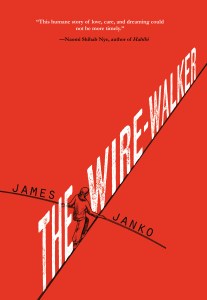
We were delighted to sit down with James Janko, the author of The Wire-Walker, to talk about life, literary pursuits, languages, science, and the value of meditation.

RHP: When did you start to write?

Janko: I was a truant in high school, but I began writing a novel my junior year. I stuffed hand-written pages into an empty tinker-toy box until it was full. I have no idea what my novel was about, but my older sister, who never missed school, read a chapter or two and said, “This is sick.”

My early efforts aside, I am a person who must write. In 1974, while living in New Orleans and working as a flower vendor on Bourbon Street, my health broke down and I was in severe pain. Three years earlier, I had returned from the Viet Nam War, where I was a combat medic in an infantry battalion commanded by Colonel George Armstrong Custer III. Nowhere felt like home after the war, so I bought a backpack, a fishing pole, and wandered the country. Hitching rides was easy for a white male in the 1970s, and finding work—I wasn’t choosy—seldom took more than a day or two. I picked strawberries in Willamette Valley in Oregon, drove a truck during a Nebraska corn harvest, a taxi in Chicago, and so on. I lived the life of a drifter, but the war followed me, more intimate than a shadow. I remember lying in bed one night, hurting all over, when I heard a voice inside me: You must write. Write something, anything. Otherwise, you’ll die.

RHP: Has your education helped you become a better writer?

Janko: After my vagabond days ended, I went to college on the GI Bill and received a B.S. in Conservation of Natural Resources from UC Berkeley. The program revived me, breathed new life into me, and sparked my creativity and love for the earth. One class in particular––Ecosystemology––had a direct influence on my first novel, Buffalo Boy and Geronimo, which highlights the environmental consequences of war. For our final exam, Arnold Shultz, a delightfully unpredictable professor, led us outside of our cramped classroom and onto the campus. Each student was free to walk about for a time, then choose one square inch of earth to write about as an ecosystem, that is, to write about the relationships between organisms, about what sustained this patch of earth. I remembered, as I was writing, that a Cobra gunship, one of the most effective killing machines of the Viet Nam War, could put a bullet in every square inch of a football field in less than a minute. And at the same time, on a blue morning in Berkeley, I learned and am still learning about the complexity of life in minuscule, one inch containing innumerable organisms and inseparable from the ebb and flow of life, inseparable from the rest of the planet! I believe what Walt Whitman believed: “…a leaf of grass is no less than the journeywork of the stars.”

RHP: Are you fluent in any other languages? If so, do you find that knowledge has any effect on your writing? Is it important for people to learn other languages? Why?

Janko: I can’t say I’m fluent in Spanish, but I’m competent enough to appreciate the untranslated poetry of García Lorca and Juan Ramón Jiménez and Antonio Machado and many others. The sounds of Spanish are sometimes supple on the tongue, sometimes fierce, and I hear, especially in Lorca, rivers and stones, love songs, castanets, and the wails of birthing and dying. What is more important in writing, meaning or sound? I don’t know, but I doubt there can be any profound meaning without close attention to sound.

I speak rudimentary Khmer, my wife’s language, and I can read and write Arabic at a first-grade level. I take great care when I write a word in Arabic. I pay homage to those long ago who invented the word, the meaning, the sound. I pay special attention to words of the earth and the elements. I can read and write in Arabic rain, waterfall, river, lake, and sixteen other words associated with water. The language finds a home in my body, the rhythm of my heart. How can this not be a boon for the difficult task of writing?

RHP: There’s a fair bit of interest, scientific and otherwise, in the links between creativity and insanity. How crazy must someone be to be a good author?

Janko: My best writing comes when I sit in a room, door closed, a cat or two at my side, and imagine my way into the lives of others.

I once said to my wife, “Forgive me if I seem distant. Sometimes I go far away when I write, but I go far away to come closer to you and the world.”

She replied, without hesitation: “Why are you nuts?”

RHP: How has Buddhist meditation supported you in your efforts to write?

Janko: I often meditate before I write. Silence is my first language. Nearly everything in the modern world encourages us to be occupied, to be addicted to our phones, to hitch a ride on the endlessly spinning hamster wheel called social media, to waste our precious lives on chats and messaging and online profiles and calculations for deepening our influence so that one day—this is the pipe dream of many writers––we’ll go viral, reach the masses, sell millions of books.

Buddhist meditation is revolutionary. There is no ambition, except to cultivate kinder and more compassionate ways of living and being. I believe there’s a deep kindness in most of my writing, and this is especially true of The Wire-Walker, whose narrator, Amal Tuqan, is the most loveable character to ever come my way. She found me in the silence, or we found each other. Amal understands the circus of life and the requirements of her profession: “The work of a funambulist is to walk in the sky on a rope, a wire, a prayer.”

James Janko is the author of the novels, What We Don’t Talk About, The Clubhouse Thief (recipient of the Association of Writers and Writing Programs (AWP) Award for the Novel), Buffalo Boy and Geronimo (recipient of The Association of Asian American Studies Book Award and the Northern California Book Award), and The Wire-Walker, which was a finalist for the 2023 Donald L. Jordan Prize for Literary Excellence, a finalist for the 2023 Dzanc Fiction Prize, and was awarded the Juniper Prize by the University of Massachusetts Press in 2021. Excerpts of The Wire-Walker appeared in the Fall/Winter 2022 issue of Nimrod International Journal. Janko’s short stories have appeared in The Massachusetts Review, The Sun, and Eureka Literary Magazine, among others. His story––“Fallujah in a Mirror”––won First Place in the Jeff Sharlet Memorial Award and appeared in the Spring 2021 issue of The Iowa Review. Janko is the recipient of an Illinois Arts Council Award for Fiction.

Filed Under: About Regal House, Author Interview, Regal Authors, Regal House Titles, That's My Story Tagged With: interview, James Janko, The Wire-Walker

Watermark Books & Café: The Literary Soul of an Evolving Prairie City

June 25, 2025 1 Comment

by Steve Heller, author of Return of the Ghost Killer

Most of the articles one reads about small independent bookstores in the USA focus on the Northeast or, more rarely, the West Coast.  But book lovers are found everywhere.  Few literary institutions demonstrate this phenomenon better than Watermark Books & Café [Link to About Us | Watermark Books] of Wichita, Kansas. 

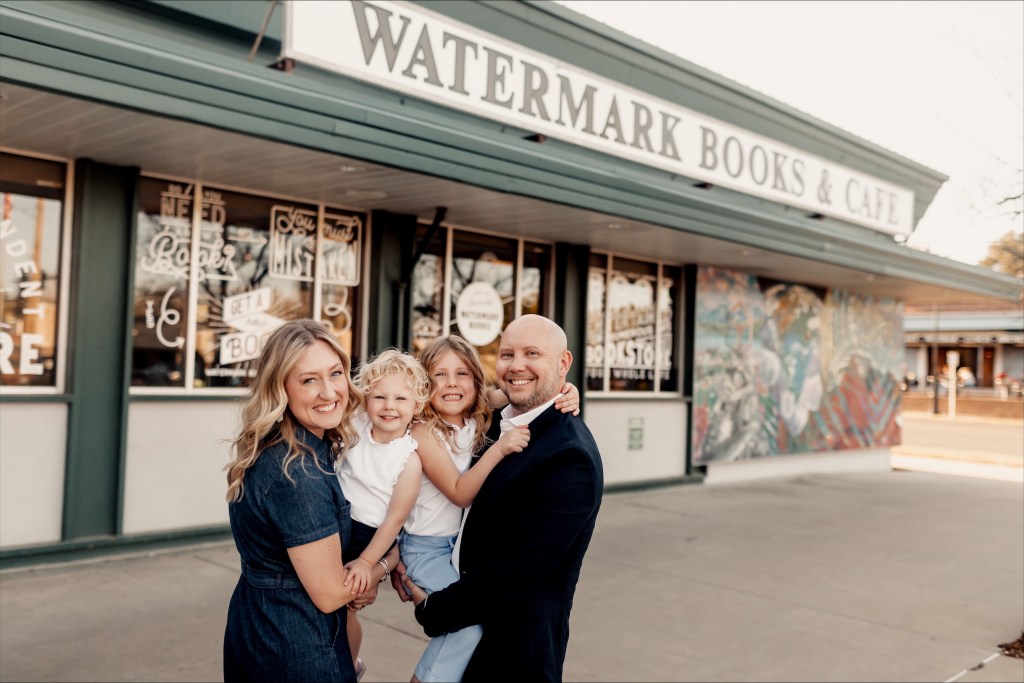
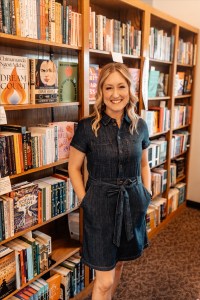
New owners Erin and Ryan Potter and their girls, Julia & Isabella

Wichita, an economically robust city of nearly half a million, was originally a village of Wichita Indians.  Over the last century and a half, the city has earned various nicknames: “Cowtown” for its Sante Fe railhead along the Chisolm Trail, “Doo-dah” for its whimsical character represented by a local diner of the same name, and the “Air Capital of the World” for its importance as an aviation design, research, and manufacturing center.  Wichita’s strong economy has led its residents to invest in obvious signifiers of high culture: a symphony, an opera house, festivals, parks, and numerous historical museums.  The most enduring evidence of Wichita’s literary culture, however, is housed in a modest strip mall near the center of the city in the comfy neighborhood of College Hill.

Co-owner Erin Potter at Watermark

I recently made two separate four-and-half-hour roundtrips from my home in Lawrence, Kansas, to Watermark Books & Café in Wichita to witness two authors launch their most recent books.  Together, these two well-attended presentations demonstrate one of the main ways new owners Erin and Ryan Potter intend to achieve Watermark’s mission, which Erin describes as “to foster a love of reading among Wichitans and beyond, preserve this wonderful space, and support authors. We envision continuing to build on the warm and inclusive environment where everyone can find their next favorite book and connect with fellow readers.”

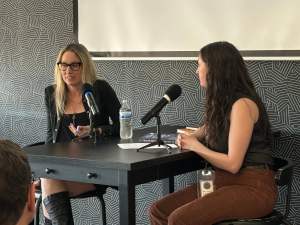
Author Page Getz interviewed by Lynne Graham

The first event involved a former student of mine, Page Getz, who grew up in Wichita.  Page’s new novel, A Town with Half the Lights On (Sourcebooks Landmark) is set in the fictitious town of Goodnight, Kansas.  Instead of reading from the text, Page was interviewed by Lynne Graham, Marketing & Events Coordinator for Watermark.  Having read the novel twice, Lynne shared her observations and impressions with the audience.  Most notably, Lynne described the impact of reading the story of the citizens of Goodnight, Kansas, as “a warm hug” but also commented on the story’s authenticity and considerable wit.

“Hosting visiting authors is a vital part of what makes Watermark a meaningful space in our community,” Co-owner Erin Potter says.  “These events offer more than just the chance to meet an author, they create moments of connection, inspiration, and shared discovery that our customers truly value. In fact, we recently completed a customer feedback survey, and the number one request when asked about our offerings was for more author and community events. It’s clear that these experiences are appreciated.”

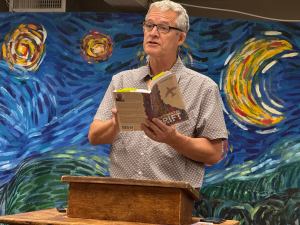
Tim Bascom reads in the “Story Time” room.  Photo by Kevin Rabas

A month later I returned to Watermark to hear award-winning author Tim Bascom give a combination lecture and reading in the “Story Time” room on the lower level, a space devoted to children’s literature events, as well as events for adults whenever the upstairs café needs to remain open.  Tim’s presentation for adults related to his new collection of short stories, Continental Drift (Main Street Rag), about characters whose adventures require them to travel between various points in the USA and Africa.  Tim’s presentation included slides from his experiences as the son of African missionaries, along with readings of representative snippets from several individual stories as well as one entire—and entirely engaging—short story, “Why I Am There, Not Here.”

By everyone’s account, the key to Watermark’s ongoing success is its staff, including Operations Manager Bethany Bayne.  Bethany originally joined Watermark in 2021 as a bookkeeper.  She describes the two main parts of her current job as “maintaining efficiency” and “teaching book people about money.”  She originally worked under the previous owner, Sarah Bagby, to whom she credits much of the store’s vision and success.  Bethany also likes the energy the new owners, the Potters, bring to the store.  “They’re also businesspeople.  They want to build a sustainable community of book buyers.  The customer base for books is aging.  We need young families, Gen Z, millennials.  College Hill residents can walk here and find a safe space.  We’ve expanded our hours to 7:00 p.m. to make Watermark more convenient for them.”

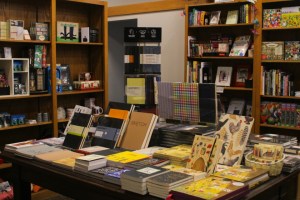
Reading accessories at Watermark

“It’s important for an independent bookstore to have multiple revenue streams,” Bethany stresses.  Aside from offering a wide variety of genres (literary fiction and nonfiction, romance, fantasy, history, and children’s literature), Watermark also sells multiple products related to reading and writing.  And then there’s the café, whose literary-themed menu includes such classics as “Moby Dick” (tuna salad with pickle relish, hard-boiled eggs, and mayo on wheat bread) and “As You Like It” (a house salad with your choice of chicken, eggs, or tuna salad with balsamic vinaigrette). 

“We want people to feel the pull to stop in for a cup of coffee and end up browsing for a new read or come in for a book and decide to stay and enjoy the café,” co-owner Erin says. “The two sides of Watermark complement each other in a way that feels natural and inviting.  Many of our customers enjoy a good cup of coffee and a pastry just as much as discovering their next great read. We’re proud to offer a space where people can connect, whether it’s for a book club, a business meeting, or simply lunch with a friend.”

Two book lovers at Page Getz’s signing in the café section of Watermark

Despite the challenges faced by brick-and-mortar bookstores across the nation, Watermark Books & Café has managed not only to endure but to thrive.  From its original staff of three, the store has grown to a total of 23 employees, nine of whom are full-time.  “The welcoming atmosphere at Watermark starts with our team,” says Erin. “We know our regulars by name, and we enjoy getting to know every person who comes through our doors. The café staff remembers customers’ usual orders, and our booksellers offer thoughtful, personalized recommendations because they’ve read the books and take the time to get to know the interests of our customers.”

I asked Erin what motivated her to take on the daunting role of owning and operating an independent bookstore in today’s economy.  I’ll let her answer conclude this review.

“Some of my favorite memories are from when I was on maternity leave with each of my girls.  I’d take them on walks through the neighborhood, wrapped in a baby sling, and we’d stop at Watermark.  It was the perfect little escape: browsing books, grabbing a coffee, and just getting out of the house for a bit.  It became something I really looked forward to.  Watermark has that kind of impact on the neighborhood; it’s a place where people feel comfortable, welcome, and connected.  It’s been that for our family, and for so many others in the community.”

Watermark Books & Café is located in Lincoln Heights Shopping Center, 4701 East Douglas Ave, Wichita, KS 67218.  Find Watermark Books & Café at Watermark Books.

Steve Heller is an award-winning novelist and short story writer and past president of The Association of Writers and Writing Programs (AWP). His latest novel, Return of the Ghost Killer, is forthcoming from Regal House Publishing in early 2027. Author photo by Aelita Parizek.

Filed Under: Book Bound Tagged With: BookBound, Steve Heller, Watermark Books and Cafe

Books, Bites, and a Big Dream: Inside Rochester, Michigan’s Charming Indie Bookshop

June 19, 2025 Leave a Comment

by Linda K. Sienkiewicz

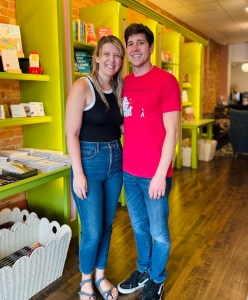
When Elliot and Rachel May dreamed of owning businesses, they pictured it ten years out: he’d open a traditional sandwich shop, and she’d have her own bookstore. They didn’t imagine those dreams would come together under one roof in downtown Rochester, Michigan. But when the idea occurred to them, it came together fast.

Their story began in a Ruby Tuesday restaurant where they both worked. Elliot was in radio broadcasting and Rachel was majoring in journalism at Oakland University. That’s when Rachel fell in love with both Rochester and Elliot.

Shortly after they met, Elliot pivoted into a corporate role at Rocket Mortgage, but he never let go of his dream to run a sandwich shop. Ten years in, he decided to enroll in culinary school at Oakland Community College to learn the craft from the ground up.

Meanwhile, Rachel built a successful career in marketing. But as artificial intelligence began reshaping the industry, she considered shifting gears and perhaps revisiting her original love: books.

“For Novel: A Bookstore and Sandwich Shop, the impetus was food,” Rachel says. But she also knew from marketing that cafes inside bookstores tend to thrive because they create multiple revenue streams. That’s if they have a real chef in the kitchen. She had that in Elliot.

The couple began scouting locations in Rochester, which was Rachel’s college-town crush. With its mix of historic charm and contemporary flair, the downtown district boasts over 350 independent businesses from salons to boutiques to award-winning restaurants. When the perfect spot popped up on Main Street, they jumped at the chance. The competition was fierce, but their concept stood out. Rochester hadn’t had an independent bookstore in years. As a writer and reader who lives within walking distance of downtown, I was sadly aware of that fact.

Elliot and Rachel wrote a business plan and submitted their bid. Shortly after, the Mays were renovating a 1907 building that had once been a dentist’s office and later a feed store before a retail space. It had its share of quirks and challenges. “Designing the kitchen was the biggest hurdle,” Rachel says. The couple hired a kitchen designer and an architect. They tore up floors, updated wiring and plumbing, and brought the space up to code.

Meanwhile, Rachel dove headfirst into the world of bookselling. She reached out to other indie bookstore owners and discovered a warm, generous community eager to help. “Booksellers are the kindest people,” she says. They gave her advice on everything from data-driven curation to customer engagement.

I often walk my dog downtown. When I first saw the sign inside the window announcing Novel: a Bookstore and Sandwich Shop was coming, I snapped a photo and excitedly shared it with my literary community. Finally! An indie bookstore! In my town! They opened in November 2025 and, much to my surprise, my husband gave me a gift card from their store for Christmas.

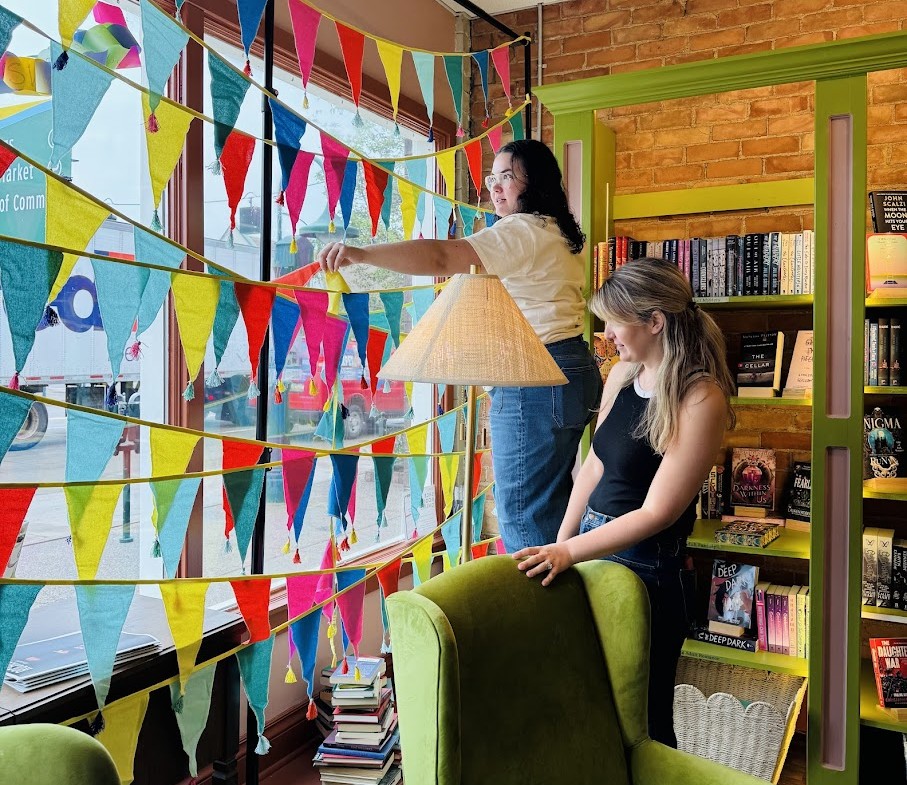
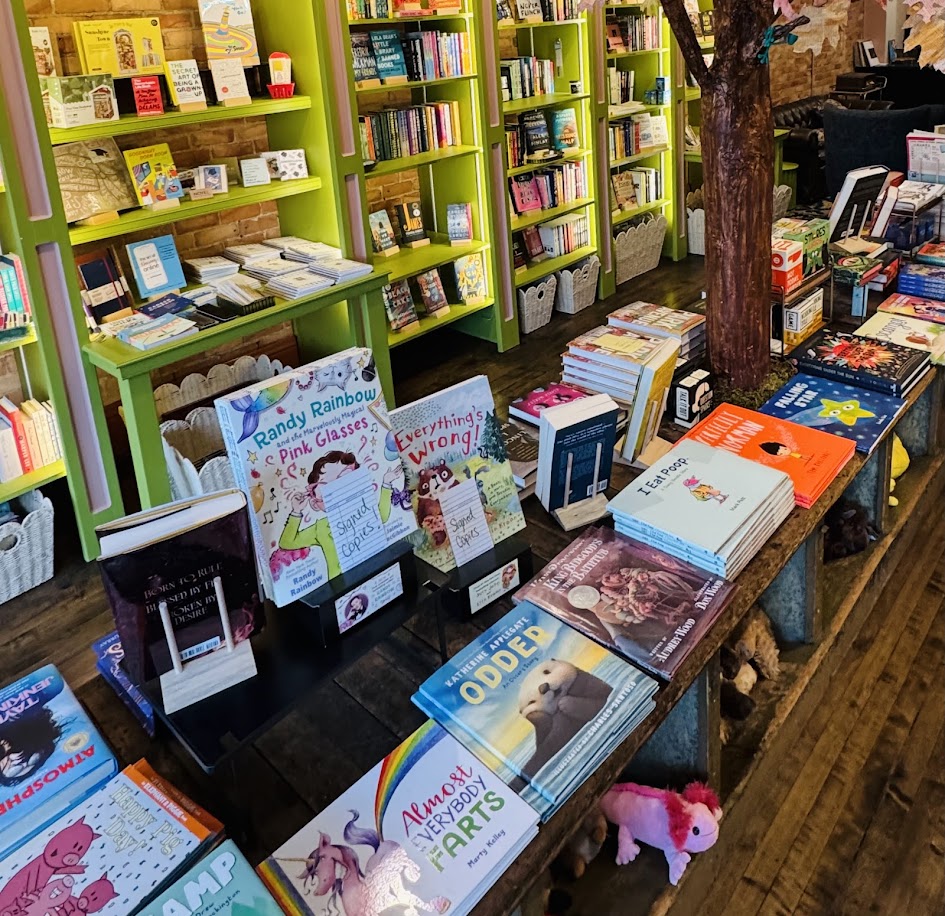
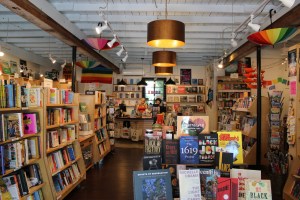
Novel is a cheerful welcoming space where visitors can sip coffee, enjoy a warm sandwich, and browse through thoughtfully curated titles. The layout invites you to linger. You’ll find a huge couch and wide chairs clustered around a coffee table, small café tables in another area, and two plush armchairs at the front. Books line the brightly lit walls and spill into baskets on the floor, many displayed face-out to catch your eye. Children’s and YA books have their own wall. Stuffed animals peek out from the bottom bins of a rustic antique center table. During my visit, two of Elliot and Rachel’s three young children were happily mingling with customers. Elliot paused to read a book to their son, while their daughter enthusiastically “helped” ring up my purchase at the counter.

One stunning feature on the center table is the tall, handmade Tree of Knowledge, which Rachel and a friend crafted from the pages of Britannica encyclopedias. Its leaves flutter from arching branches and the trunk is wrapped in printed pages, making a tactile symbol of the stories and knowledge that fill the shop.

In the café, Elliot crafts one-of-a-kind grilled sandwiches, like the Mortadella Truffle, my personal favorite, layered on artisanal CRUST bread from a local bakery. The cheese in the sandwiches comes from another local shop, The Cheese Lady. The menu also features CRUST pies and bakery, soups, and coffee and cold drinks. This is elevated comfort food with Michigan-made heart.

What sets Novel apart from chain bookstores is the personal connection. “Talking to customers is my passion,” Rachel explains. She recently spoke with someone who claims they read only one book a year because they don’t know what to read anymore. Big box stores are overwhelming with massive displays that often lead to impulse buys and reading letdowns. At Novel, Rachel strives to curate her collection not just from bestseller lists and reviews, but from conversations. She learned from Rochester’s annual sidewalk sale that the community enjoys romance, historical fiction, YA thrillers, and true crime, not necessarily what’s on a list.

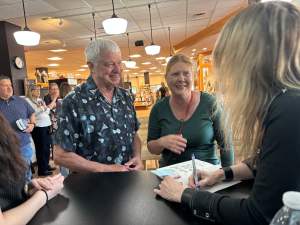
To help guide readers, she’s created a “If you like this → try this” shelf and encourages customer-written review cards that are displayed alongside featured books. “I hope to build trust with readers,” she says. Return customers mean everything, and Rachel is delighted to see that happening as Novel is becoming a community hub. Weekly story time for kids is led by local teachers. There are adult book clubs, puzzle nights and game nights. Their recent “Spicy Boozy Book Fair” and “Mystery Boozy Book Fair” events, hosted with Bitter Tom’s Tasting Room just a few doors down, were big hits.

Bookstore: A Bookstore and Sandwich Shop is more than the sum of its parts. It’s a love story of food, books, Rochester, community, and a couple who dared to build something original, meaningful, and warmly unforgettable.

Find them at 307 S. Main Street, Rochester, MI. 48307.

Website: Novel | Sandwiches and Book Store in Rochester, MI.

Follow them on Instagram and Facebook.

Linda K. Sienkiewicz is a poet and author whose work has appeared in numerous journals and anthologies. Her debut novel, In the Context of Love, was a finalist for multiple awards including the Hoffer Award and Sarton Women’s Fiction Award. She has five poetry chapbooks and a children’s picture book. Her novel Love and Other Incurable Ailments is forthcoming from Regal House in Fall 2026. Linda volunteers at Neighborhood House, a local nonprofit in Michigan.
Filed Under: Book Bound Tagged With: BookBound, Linda K. Sienkiewicz, Novel: A Bookstore and Sandwich Shop

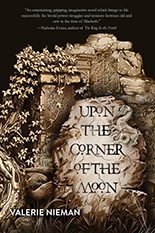
Letting the Story Lead: Valerie Nieman and Upon the Corner of the Moon

March 10, 2025 1 Comment

by Valerie Nieman

Writers are not our characters, most times, though these characters may draw upon our lives, our experiences, our quirks.

Macbeth and Gruach, the main characters of Upon the Corner of the Moon, definitely are not “me” except that I was drawn to the story and felt the urge to tell it – an urge that stayed with me for almost 30 years.

I first came across the facts about the historical Macbeths when I was researching an earlier novel. I did not realize how thoroughly this story had been reversed: Macbeth was a rightful king based on Celtic traditions and ruled for 17 years, being called “The Righteous” and “the ruddy king of plenty.”

How did he become a villain?

Macbeth was cousin to Duncan, and yes, he did kill him – but in battle when Duncan invaded his territory. Duncan’s son Malcolm Canmore eventually claimed the throne through primogeniture and the Celtic system of electing kings was erased. Chroniclers grafted Macbeth’s story with various legends to shape a monstrous, murdering usurper. Shakespeare found this tale in Holinshed’s Chronicles, shaped it to please King James and included the witches that so fascinated the king.   

As to “Lady Macbeth,” we know little more than her name and her father’s name. We do know that she was married to a man called Gillecomgan, also killed in battle by Macbeth, and then married Macbeth. I had to do a great deal of speculation in building a plausible life for her but drew on scholarship from a number of areas including archaeology of the Picts and the study of ancient goddess religions.

This book is the first of two telling the story of the historical Macbeths, hewing to the record where it exists and speculating to fill in the gaps. The Last Highland King will come out in 2027.

My earlier book with Regal House, In the Lonely Backwater, featured the distinctive voice of Maggie, who owes a lot to the solitary girl that I was, simultaneously lost and found between the wonders of the natural world and the books she carried everywhere.

I grew up in New York State, near the headwaters of the Allegheny River. My parents owned fields and woods that I knew well before I learned to read. I fished with my dad and wandered a patch of old-growth forest. Books sustained me — Twain, Poe, and Tennyson in addition to Shakespeare, all in the tall bookcase upstairs – along nature guides, and A Girl of the Limberlost that featured another rural wanderer. Like Maggie, I brought back my finds and interpreted them, generally to amused interest.

After high school and a few erratic years where I took jobs in factories and donut shops while in community college, I slid south along the Allegheny’s path to find myself at the other end of that river system, attending West Virginia University on the banks of the Monongahela. Propelled by the desire to write, I’d determined to become a journalist, as a blue-collar kid lacking mentors to help me along the path toward becoming a novelist and poet.

For nearly twenty years, I worked as a reporter and editor for daily newspapers in the northern coalfields of West Virginia, covering everything from train wrecks to murders to acid spills in the rivers, along with government beats and the “hook and bullet” column that let me hang with scientists at the Department of Natural Resources. During that time, I homesteaded a hill farm with my then-husband, building a house and barn, planting an orchard and organic garden — and, of course, wandering with my dog and gathering wild foods and always writing.

My first poetry chapbook and my first novel, both deeply engaged with the natural world, came out in 1988. Neena Gathering, a post-apocalyptic tale based on the landscape around that farm, was long out of print before being brought back as a classic in the genre. Like In the Lonely Backwater, it features a teenage narrator, though at its debut, Young Adult was not yet a thing and it was listed with general SF paperbacks. I still love that book, and it has many fans who’ve applauded its reissue.

Things change. The marriage ended and I found myself with a small farm I couldn’t manage and the editorship of a newspaper destined for sale. I headed to the Piedmont of North Carolina for a job with the News & Record, living outside of Appalachia for the first time in my life. The move brought new adventures, from getting my MFA at Queens University of Charlotte, to the publication of more poetry and fiction, to learning how to sail. A 25-foot Hunter docked at Lake Kerr was direct inspiration for Maggie’s world of the marina and the landscape of the farms and piney woods of the coastal plain.

I had the pleasure of working with Kevin Watson at Press 53 for all three of my full-length poetry collections and my novel Blood Clay, set in North Carolina. I was delighted when West Virginia University Press, which had also released my short fiction collection, decided to publish To the Bones, a horror/mystery set in the coalfields. It was acclaimed as “a parable of capitalism and environmental degradation” and in the sequel, Dead Hand, Darrick and Lourana flee to Ireland in search of answers to questions raised in the first book.

And then my Queens classmate Pam Van Dyk made me aware of Regal House, and I met Jaynie Royal and all the wonderful folks at my most excellent publisher!

Another marriage came and went, and I found myself freed to wander more widely. Solo hiking was pure pleasure, even when I was quite lost on the trails near Les Eyzies-de-Tayac, slogging through the rain along the Great Glen Way in Scotland, or following the music in Donegal and Dingle. Trailheads beckon me, from the Mountains to the Sea trail in North Carolina to the coastal vistas of San Francisco Bay.

Along the way, I’ve published poetry widely, in The Georgia Review, The Missouri Review, Chautauqua, and journals across the U.S. as well as Scotland, Ireland, and Greece. Work has also appeared in some fine anthologies, including Eyes Glowing at the Edge of the Woods and Ghost Fishing: An Eco-Justice Poetry Anthology.

I have been a creative writing fellow for North Carolina and West Virginia, the Kentucky Foundation for Women, and the National Endowment for the Arts. I’m professor emerita of creative writing at North Carolina A&T State University and continue to teach writing workshops.

Filed Under: Author Interview, Literary Musings, Regal Authors, Regal House Titles Tagged With: Historical Fiction, Upon the Corner of the Moon, Valerie Nieman

Ease What Ails You at UpUp Books

February 19, 2025 Leave a Comment

by Elizabeth Costello

Michelle Gutman; photo credit: Isa Hammond

I had a great time talking with Michelle Gutman of UpUp Books in Portland, Oregon, about how to bring people together through books. Gutman opened UpUp in 2023, after starting on a social service path during the pandemic. She was working with children, getting trained to address domestic violence and prevent suicide, and she was moved by connecting with others, but she felt that something wasn’t quite right. A lifelong reader who grew up with poets and artists, Gutman realized that what she always wanted to do was to open a bookstore — and that doing so would scratch her itch to bring people together.

“I realized…it’s not something I’m running but the community’s running, that I can have a bookstore that has a workshop space and functions like an apothecary,” said Gutman. “You come in and you’re not feeling so great, and you’re drawn to what’s going to ease your ailments.”

Gutman had previously lived in Buckman (in NE Portland) and knew right away that that was the neighborhood for her store. From the beginning, she approached UpUp as a place that would be responsive to the changing needs of the neighborhood. She was fully aware that Portland already had a thriving ecosystem of great bookstores and wanted to focus on small presses, local authors, and two-wheeled literary outreach.

“I quickly formed a relationship with Street Books, which is a bicycle-powered library for those living outside. They’re one block down,” she said, noting that the proximity meant she could make an immediate positive impact by serving as a conduit for book donations. “Because they’re so close and only open on Tuesday, I thought why don’t people just drop off books for them here. Then I did a fundraiser at my shop for their spring campaign, featuring local poets Matthew Dickman and Marcus Lattimore. Marcus is an ex-football player and an amazing spoken-word poet who takes a typewriter to different places in Portland, asks people to give him a word and writes a poem with it on the spot.”

Gutman knew that she wanted to have a “kickass” poetry section, but the business reality soon became apparent. As she started buying books for the shop, she discovered poetry volumes are expensive, and because they tend to be physically small, they are easy for the casual shopper to miss. After talking to a friend about the layout of the shop, she decided to put poetry on the new arrivals shelves that prop books up to showcase the full cover. When you walk into UpUp, beautiful poetry collections are the first thing you see.

I asked Gutman what she has found surprising in terms of sales, and I was pleased to learn that she sells a lot of fiction.

“It’s interesting to see what people gravitate towards,” she said, noting that she assumed there would be more interest in nonfiction. “Although there is interest in social justice and climate change, there is not as much as I thought, and people are more interested in local authors and fiction.”

UpUp: a cozy, welcoming space. Photo credit: Christopher Dribble

I’m hoping people will pick up a copy of my novel The Good War at an event at UpUp that I’m offering there on March 6th with another Portland writer, Mary Rechner, whose most recent book, Marrying Friends, is out from local small press Propeller Books. I was inspired by UpUp’s eclectic programming to suggest that we discuss books that have had an influence on our work as well as reading from our own books. We will also invite the audience to share their thoughts about books that have made a big impression on them.

UpUp is the sort of cozy and attractive space that makes you want to engage with your fellow readers, writers, and artists. In the workshop space in the back of the store, paintings by Gutman’s father hang on the walls. There you can take a workshop such as “Eno/Ono,” which invites writers to employ some of the strategies musicians use to generate new work or participate in Gutman’s six-week series engaging with Julia Cameron’s The Artists Way. Gutman also offers a semi-monthly book club where she leads the conversation artfully — she comes prepared with great questions but knows how to pass the mike.

Gutman notes that everything in her store is on wheels, which makes it easy to rearrange the space for hosting events and gathering community. Her many upcoming plans for UpUp include hosting a roundtable discussion and fundraiser for local food magazine Kitchen Table on Thursday, March 27th, and a 15-year celebration for Street Books on Thursday, April 10th. She is also working on creating “book boxes,” artfully packaged sets of works that work well together — kind of like an herbalist at an apothecary, putting together the teas and tinctures to lift you up or calm you down. I recommend you check out UpUp when you’re in Portland — it’s a perfect place to browse and find that special something you didn’t know you needed.

Author of The Good War and RELIC, Elizabeth Costello was a finalist for the James Jones First Novel Fellowship and the Pirate’s Alley William Faulkner Award. She has written about dance, film, theater, and poetry for SF Weekly and 7X7. Her poetry has been published in venues including The Buffalo Evening News, Crab Orchard Review, Fourteen Hills, and the Solitary Plover.

Filed Under: Book Bound Tagged With: BookBound, Elizabeth Costello, Independent Bookstores, Portland, UpUp Books

Elephant Ear Books: Plymouth’s New Literary Haven

December 18, 2024 Leave a Comment

by Megan Schikora

As someone who moved from Detroit to Plymouth as a kid, returned to Plymouth every time I moved away, and has lived here now since 2010, I have been asking the same question for years. “Why doesn’t Plymouth have a bookstore?” As an avid reader, I have felt the absence of such a staple in this otherwise vibrant downtown area, flush with shoppers and thriving shops.

Then, in November, a friend texted me. “Did you know a bookstore just opened in Plymouth?” The next day, I hustled over to Elephant Ear Books.

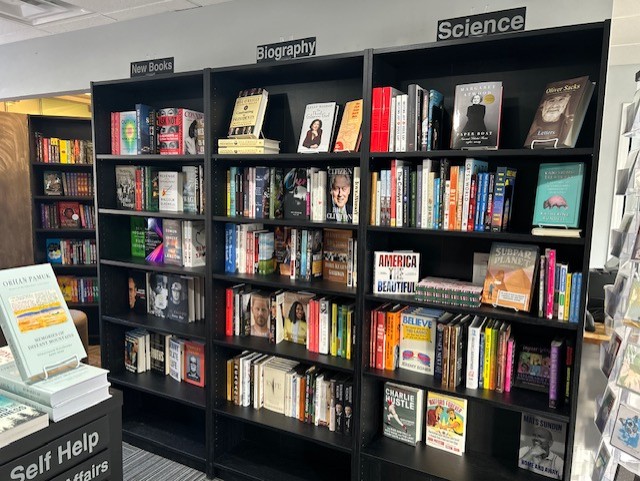
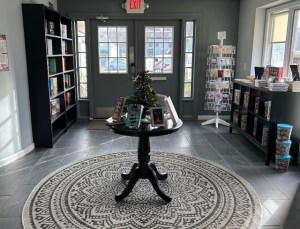
The store is part of a collection of businesses at Ann Arbor Trail and Harvey Street that look from the outside like cozy cottages nestled close. Inside, the gray walls, black shelves, and generous sunlight create an atmosphere both modern and warm, a combination of clean lines and soft touches. The comfortable minimalism of the space allows the books themselves to step forward as the focal point.   

The owner is Melissa Schabel, who doesn’t quite know how to answer when people ask, “Where are you from?” She’s lived all over, including New Hampshire, Boston, Arizona, New Jersey, Ireland, and Texas. In 2020, she had the opportunity to buy the house next door to her best friend in Saline, Michigan, where she now lives with her husband and two sons.

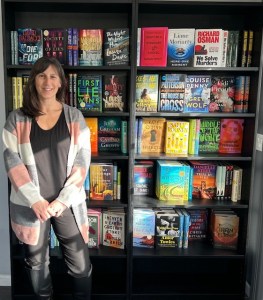
Melissa is a librarian, former bookstore employee, creator of her store’s beautiful handmade greeting cards, and a lifelong book lover who used to spend all her babysitting money in bookstores. She reads anything that strikes her, but she has a penchant for fiction, naming J. Courtney Sullivan’s The Cliffs and Liz Moore’s The God of the Woods as favorite recent reads. Though she loved her library work, she realized she wanted to open a store of her own and decided last year, “If I don’t do it now, it’s never going to happen.” Spurred on by the loss of her father, she committed to the undertaking. “You can’t have regrets. You have to jump.”

While looking for a space, someone suggested she visit Plymouth. Seeing it for the first time, she says, “My shoulders dropped. [I knew] this is the type of place I want to be in.” Her family was a huge help in preparing the store for opening, and Melissa DIYed whenever and wherever possible to keep costs under control. In November, she cut the ribbon on Elephant Ear Books, the name a fun nod to her love of elephants.   

Now, Melissa can be found behind the counter every day, greeting customers who tell her how glad they are that she’s here. She loves talking about books with customers and wants to know what they like to read. She’s also happy to place special orders and wants to expand her unique, thoughtfully curated inventory to reflect the tastes of the community. “I want to be the community bookstore.”

Like all independent bookstores, Melissa faces challenges around visibility, competition with retail giants, and the limitations of physical space. Down the road, she would like to host store events, and she will feature local authors, beginning with Michigan native Breeda Miller. The Plymouth Chamber of Commerce has been a great support, and word of mouth continues to spread. In the three weeks since Elephant Ear Books opened, the store already has repeat customers.        

About Elephant Ear Books, Melissa says, “It really is my happy place,” a realized dream of owning and running a bookstore in a walkable downtown area. And as someone who really values living in a walkable downtown area, I’m delighted that Elephant Ear Books has arrived. For me, there are few greater pleasures than walking into a bookstore. Entering that intimate physical space, touching and smelling the books, browsing and making selections – it’s a sacred experience. Now, to have it, I don’t have to leave my town.

Elephant Ear Books is located at 449 S. Harvey Street in Plymouth, MI 48170. (734) 453-4707. Find Elephant Ear Books at https://bookshop.org/shop/elephantearbooks

Megan Schikora worked in mental health and higher education for many years before turning her full attention to writing. Her short stories and personal essays have appeared in numerous publications, and her debut novel A Woman in Pink was a Writing Award Short List choice for the 2023 Page Turner Awards. She lives in Michigan with her daughter.

Filed Under: Book Bound Tagged With: Bookstore, Elephant Ear Books, Megan Schikora, Plymouth

  • Page 1
  • Page 2
  • Page 3
  • Interim pages omitted …
  • Page 12
  • Go to Next Page »

Footer

The Regal House Enterprise

Regal House Publishing is the parent company to the following imprints:

Fitzroy Books publishing finely crafted MG, YA and NA fiction.

Pact Press publishing finely crafted anthologies and full-length works that focus upon issues such as diversity, immigration, racism and discrimination.

The Regal House Initiative, a 501(c)(3) nonprofit that conducts project-based literacy and educational outreach in support of underserved communities.

From our Blog

Dockside Books: An Up North Haven for Thinkers, Adventurers, and Creatives

Tombolo Books: a book lover’s loveshack in downtown St. Pete, Florida

That’s My Story: Regal House Publishing (RHP) Interviews Novelist James Janko

  • Facebook
  • Twitter
  • LinkedIn
  • Google +
  • Email
Regal House Publishing · © 2017–2025 · Website design by Lafayette & Greene
 

Loading Comments...