We were delighted to sit down with James Janko, the author of The Wire-Walker, to talk about life, literary pursuits, languages, science, and the value of meditation.
RHP: When did you start to write?
Janko: I was a truant in high school, but I began writing a novel my junior year. I stuffed hand-written pages into an empty tinker-toy box until it was full. I have no idea what my novel was about, but my older sister, who never missed school, read a chapter or two and said, “This is sick.”
My early efforts aside, I am a person who must write. In 1974, while living in New Orleans and working as a flower vendor on Bourbon Street, my health broke down and I was in severe pain. Three years earlier, I had returned from the Viet Nam War, where I was a combat medic in an infantry battalion commanded by Colonel George Armstrong Custer III. Nowhere felt like home after the war, so I bought a backpack, a fishing pole, and wandered the country. Hitching rides was easy for a white male in the 1970s, and finding work—I wasn’t choosy—seldom took more than a day or two. I picked strawberries in Willamette Valley in Oregon, drove a truck during a Nebraska corn harvest, a taxi in Chicago, and so on. I lived the life of a drifter, but the war followed me, more intimate than a shadow. I remember lying in bed one night, hurting all over, when I heard a voice inside me: You must write. Write something, anything. Otherwise, you’ll die.
RHP: Has your education helped you become a better writer?
Janko: After my vagabond days ended, I went to college on the GI Bill and received a B.S. in Conservation of Natural Resources from UC Berkeley. The program revived me, breathed new life into me, and sparked my creativity and love for the earth. One class in particular––Ecosystemology––had a direct influence on my first novel, Buffalo Boy and Geronimo, which highlights the environmental consequences of war. For our final exam, Arnold Shultz, a delightfully unpredictable professor, led us outside of our cramped classroom and onto the campus. Each student was free to walk about for a time, then choose one square inch of earth to write about as an ecosystem, that is, to write about the relationships between organisms, about what sustained this patch of earth. I remembered, as I was writing, that a Cobra gunship, one of the most effective killing machines of the Viet Nam War, could put a bullet in every square inch of a football field in less than a minute. And at the same time, on a blue morning in Berkeley, I learned and am still learning about the complexity of life in minuscule, one inch containing innumerable organisms and inseparable from the ebb and flow of life, inseparable from the rest of the planet! I believe what Walt Whitman believed: “…a leaf of grass is no less than the journeywork of the stars.”
RHP: Are you fluent in any other languages? If so, do you find that knowledge has any effect on your writing? Is it important for people to learn other languages? Why?
Janko: I can’t say I’m fluent in Spanish, but I’m competent enough to appreciate the untranslated poetry of García Lorca and Juan Ramón Jiménez and Antonio Machado and many others. The sounds of Spanish are sometimes supple on the tongue, sometimes fierce, and I hear, especially in Lorca, rivers and stones, love songs, castanets, and the wails of birthing and dying. What is more important in writing, meaning or sound? I don’t know, but I doubt there can be any profound meaning without close attention to sound.
I speak rudimentary Khmer, my wife’s language, and I can read and write Arabic at a first-grade level. I take great care when I write a word in Arabic. I pay homage to those long ago who invented the word, the meaning, the sound. I pay special attention to words of the earth and the elements. I can read and write in Arabic rain, waterfall, river, lake, and sixteen other words associated with water. The language finds a home in my body, the rhythm of my heart. How can this not be a boon for the difficult task of writing?
RHP: There’s a fair bit of interest, scientific and otherwise, in the links between creativity and insanity. How crazy must someone be to be a good author?
Janko: My best writing comes when I sit in a room, door closed, a cat or two at my side, and imagine my way into the lives of others.
I once said to my wife, “Forgive me if I seem distant. Sometimes I go far away when I write, but I go far away to come closer to you and the world.”
She replied, without hesitation: “Why are you nuts?”
RHP: How has Buddhist meditation supported you in your efforts to write?
Janko: I often meditate before I write. Silence is my first language. Nearly everything in the modern world encourages us to be occupied, to be addicted to our phones, to hitch a ride on the endlessly spinning hamster wheel called social media, to waste our precious lives on chats and messaging and online profiles and calculations for deepening our influence so that one day—this is the pipe dream of many writers––we’ll go viral, reach the masses, sell millions of books.
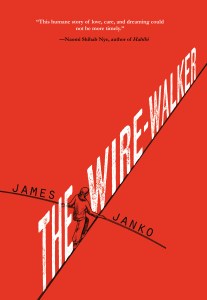
Buddhist meditation is revolutionary. There is no ambition, except to cultivate kinder and more compassionate ways of living and being. I believe there’s a deep kindness in most of my writing, and this is especially true of The Wire-Walker, whose narrator, Amal Tuqan, is the most loveable character to ever come my way. She found me in the silence, or we found each other. Amal understands the circus of life and the requirements of her profession: “The work of a funambulist is to walk in the sky on a rope, a wire, a prayer.”
James Janko is the author of the novels, What We Don’t Talk About, The Clubhouse Thief (recipient of the Association of Writers and Writing Programs (AWP) Award for the Novel), Buffalo Boy and Geronimo (recipient of The Association of Asian American Studies Book Award and the Northern California Book Award), and The Wire-Walker, which was a finalist for the 2023 Donald L. Jordan Prize for Literary Excellence, a finalist for the 2023 Dzanc Fiction Prize, and was awarded the Juniper Prize by the University of Massachusetts Press in 2021. Excerpts of The Wire-Walker appeared in the Fall/Winter 2022 issue of Nimrod International Journal. Janko’s short stories have appeared in The Massachusetts Review, The Sun, and Eureka Literary Magazine, among others. His story––“Fallujah in a Mirror”––won First Place in the Jeff Sharlet Memorial Award and appeared in the Spring 2021 issue of The Iowa Review. Janko is the recipient of an Illinois Arts Council Award for Fiction.


