• Skip to primary navigation
  • Skip to main content
  • Skip to footer

Regal House Publishing

Advancing Finely Crafted Literature

  • Home
  • About Us
    • The Origin Narrative of an Indie Press
    • The Regal Mandate
    • Our Imprints
    • The Regal House Initiative
    • Regal House Publishing Staff
    • Our Professional Affiliations
    • RHP’s Climate Commitment
    • Helen Keller Intl
    • RHP Summer Scholars Program
    • Contact & FAQ
    • Blog
  • Authors
    • Our Authors
      • Regal House Authors & Poets
      • Fitzroy Books Authors & Poets
      • Pact Press Authors & Poets
    • Forthcoming Publications
    • Sour Mash: RHP’s Southern Literature Series
    • Fugere Books: RHP’s Novella Series
    • Regal House Reading Series
    • Author Resources
  • Submissions
  • Marketing & Distribution
    • Our Distribution and Printing Partners
    • Subsidiary Rights
    • For Retailers
    • Events
    • A Conspiracy of Lemurs Podcast
  • Contests
    • The Fugere Book Prize for Finely Crafted Novellas
    • The Petrichor Prize for Finely Crafted Fiction
    • The W.S. Porter Prize for Short Story Collections
    • Past Contests
      • The Kraken Book Prize for Middle-Grade Fiction
      • The Acheven Book Prize for Young Adult Fiction
    • The Terry J. Cox Poetry Award
  • SHOP

Blog

Book Bound: A Celebration of Independent Bookstores

September 1, 2017 Leave a Comment

Ruth’s Bookstore Safari, Part I: An Indie in the Pacific Northwest

Third Place Books
Visited: 15 May, 2017

          I began my bookstore safari in Seattle, Washington, where I was visiting my particular friend Maren Donley. Before I arrived, I explained my quest to her, and she immediately recommended a visit to the Third Place Books. While there are three Third Places (I’m not sure how the math works on that, whether it requires simple addition or some kind of quantum exponential multiplication), Maren suggested we drop by the Lake Forest store. “I drive by it twice a week. I had never been in until I met my priest there for a meeting. Then I said, ‘Oh! I have really been missing out!'” she told me.

As always, Maren’s advice proved invaluable. I contacted the store and was put in touch with Zak Nelson, the Events and Marketing Manager. Mr. Nelson gave me some background, drawn from the website, on the store and its philosophy. He explained that “Third Place Books is the deliberate and intentional creation of a community around books and the ideas inside them” and that the name, Third Place Books, comes from sociologist Ray Oldenberg’s idea “that each of us needs three places: first is the home; second is the workplace or school,” and a third place “where people from all walks of life interact, experiencing and celebrating their commonality as well as their diversity.”
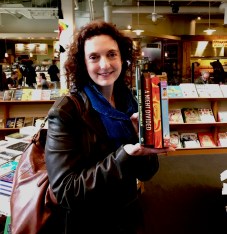
Maren, my trusty guide

Maren commented on this aspect of the store as well. After our visit, she remarked, “I appreciate that so much of that space is devoted to the community and I will go out my way to make purchases there because I value that space. I have never found anywhere else that can do that.” Before visiting the book store, Maren and I fortified ourselves with lunch at the Everest Kitchen, a few doors away from Third Place. We find Indian food tends to be the best way to prepare for about anything, and we wanted to ensure we would have sufficient stamina for an extended exploration.
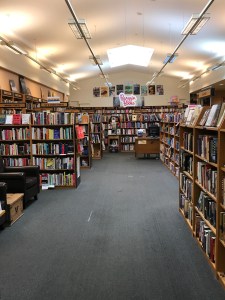
When Maren and I walked into the Lake Forest Third Place, the atmosphere and layout were genuinely comfortable and intriguing. It felt almost as much like a library as a book store, a place where one could take the time to get to know a book before deciding whether to take it home.

Mr. Nelson had suggested that I speak with Robert Sindelar, the Managing Partner and now president of the American Booksellers Association. When Maren and I arrived, Mr. Sindelar was working in the back, but one of the clerks at the customer service desk cheerfully went off to find him. Mr. Sindelar came out and showed me around the store and talked about his store’s commitment to authors.

Third Place hosts authors—both new, local writers and established celebrities—fifteen times a month. The traditionally published authors have their publishers behind them to arrange readings and signings, while local authors must approach the store in person to arrange appearances and apply to have Third Place carry their books in the stores. When considering self-published works, the Third Place staff take into account not only the quality of the books, but also whether the authors are motivated self-promoters.

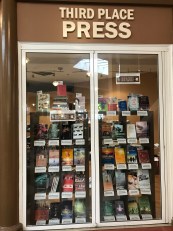
As an additional support to Seattle-area authors, the book store offers Third Place Press for those who want to self-publish. The Press designs books and publishes them using its Espresso Book Machine. The Third Place Press office is located not in the book store itself, but in the Commons, near the stage. Many of the books produced there are displayed in the window of the office. It should be noted that publishing with Third Place Press does not guarantee that the book store will carry the book produced. TPP authors must go through the same application process as other independent writers. Mr. Nelson wrote me that the stores carry local authors’ works on consignment.
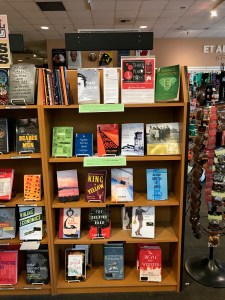
          The selection of books, Mr. Sindelar told me, has a curatorial aspect. The staff have a lot of say in the choices, which are also guided by the interests of customers and the diverse ideas and opinions that represent the neighborhood. It seems that every aspect of Third Place is indeed geared toward fostering community and neighborhood. The Commons area not only has ample seating and a play area for small children, it has three restaurants as well: sustenance for both mind and body.

And then there’s the stage. The bookstore uses it for readings and signings, and shares it with schools, musicians, and theatre groups as another way to create inclusive and cohesive bonds between various individuals and groups in the area. Mr. Nelson, in one of his e-mails, had assured me that Third Place “depends on having a well-rounded and enticing events program.”

When Mr. Sindelar had to take his turn staffing the information counter, I explored the store some more on my own and eventually found Maren in the children’s section with Rene Holderman, one of the store clerks who had greeted us when we first arrived. Maren was looking for books for her children, both voracious consumers of literature. On the way home, Maren confided that “This is the second time that Rene has been able to help me select books for my daughter. She’s an avid reader with VERY specific tastes. It’s such a pleasure to have expert help.”
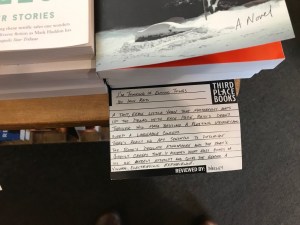
          As we wended our way toward the registers at the front of the store, Maren pointed out the cards that annotated the books on the tables and shelves. The cards offered reviews by the staff, noted awards won by the book and author, and even let browsers know that a less expensive edition of the book in question was available on a different shelf in the store. I had seen cards similarly deployed in other stores, but never to such good effect. Walking through the store while looking at the books and reading the cards was like enjoying a stimulating conversation with friends or taking part in a silent book club discussion.

Third Place is a community epicenter that extends opportunities for education and enjoyment. While Third Place strives to be a place apart from home and work or school, I think it might be something better: a place that embraces aspects of all our important environments and makes room for members of the community to nurture their separate selves within while forging connections with the world around them.

The umbrella that marks the children’s section.
A selection of Third Place Press publications
The Den sits in the heart of the store.
https://regalhousepublishing.com/wp-content/uploads/2017/08/IMG_9113-1.m4v

A quick look at The Commons and Third Place Books.

          I want to thank Zak Nelson and Rene Holderman for their assistance; I am particularly grateful to Robert Sindelar for his time and kindness in showing me around. And especial gratitude to Maren Donley for leading me to Third Place Books, and for more than I can articulate here.

Filed Under: Book Bound Tagged With: Bookstore Bound, Bookstore Safari, Celebrating Independents, Espresso Book Machine, Independent Bookstores, literary fiction, Maren Donley, Rene Holderman, Robert Sindelar, ruth feiertag, Seattle, Third Place Books, Third Place Press, Washington, Zak Nelson

Book Bound: A Celebration of Independent Bookstores

August 15, 2017 7 Comments

A few months ago, our intrepid leader, Jaynie Royal, suggested that we, as members of an independent publisher’s community, undertake a challenging new adventure: to seek out independent book stores; talk with the people who own, run, and staff them; and celebrate these stores and staff in a continuing series on the Regal blog. Jaynie wanted to give store owners a chance to tell their stories and to inspire other bibliophiles locally, nationally, and across the globe to appreciate the essential role independent book stores play in the author-publisher-reader symbiosis.

We would write up the tales of our forays into the worlds of our counterparts to inform our readers about these bastions of literacy, to entertain our readers with our escapades, and to express our support and encouragement for the individuals and institutions that keep the indie scene vital and vibrant.

Here us our first installment.

Quail Ridge Books
North Hills
4209-100 Lassiter Mill Road
Raleigh, North Carolina
27609
(919) 828-1588

http://www.quailridgebooks.com

Visited: 5/21/17

Quail Ridge Books: A Literary Haven in Raleigh, North Carolina


Quail Ridge Books, In the Ink, Celebrating Indie Bookstores, A Regal House blog seriesBookstores, for me, have always been imbued with magic: their exterior signage, the glimpse of books and bindings through gleaming glass windows sound a magnet call that I am utterly helpless to resist. It little matters whether the bookshop is a dusty repository of the previously loved or a modern facility that houses the recently released, but it must be independent—chains necessarily lack the vibrant individuality that differentiates one store from the other.

Having recently moved to Raleigh, North Carolina, I was unacquainted with its literary scene and worried that quality independent bookstores might be in short supply. Needless to say, I was thrilled to discover the joy that is Quail Ridge Books—itself having recently moved from Ridgewood Shopping Center to its glorious new store in North Hills. For the owner and staff’s passionate support for independent authors, poets, and presses, for their ongoing collaboration with independent booksellers across the Piedmont[1], and for their unceasing devotion to the Raleigh writing and reading community, Quail Ridge Books deserves the inaugural place in our “Celebrating Indie Bookstores” blog series.

Quail Ridge Books, in its reincarnation in the North Hills shopping center, is an enticing space, one in which warm hues and artfully inscribed literary quotations decorate the walls. Reading nooks present inviting spaces to linger and browse while bright, brocaded armchairs with sink-in cushions are situated next to a faux gas fireplace or grouped in proximity to convenient tables that will host the inevitable stack of books you will end up carrying around with you.

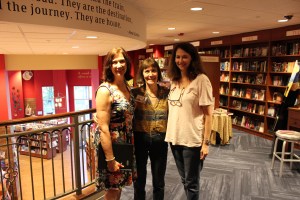
Lisa Poole, the owner, René Martin, the events coordinator, and Sarah Goddin, the general manager of Quail Ridge Books

Lisa Poole, the owner of Quail Ridge Books, René Martin, the events coordinator, and Sarah Goddin, the general manager, were kind enough to sit down with me one afternoon this summer to talk about the Quail Ridge Books enterprise. A lovely chat ensued between us four in a delightfully snug corner of the Young Adult fiction section.

The story began, as they usually do, at the beginnings of things, at “Once upon a time…,” when Quail Ridge Books’ founding editor, Nancy Olson, received a small inheritance from her uncle and used it to start the bookstore. She had recently moved from Virginia to Raleigh and had noticed the lack of independent book shops. Nancy moved the bookstore to Ridgewood Shopping Center in 1994, then Lisa Poole bought the store from Nancy when the latter retired in 2013.

Quail Ridge Books has sought to promote and nurture Raleigh readers and writers ever since with a vibrant event schedule that features a mix of local, national, and international authors. There is a lively writing community in the Triangle, and Quail Ridge Books accepts a fair number of books on consignment, some of which are self-published. Twice a year, their bestselling self-published authors come in to give a presentation. A quarterly event showcases North Carolina poets, a series of workshops for writers examines both traditional and self-publishing options, and other events help writers establish ways in which they can promote and market their work.

While adults seeking a warm and engaging book-purchasing, event-offering space emerge deeply satisfied, the next generation of readers is equally well catered to.

In the best tradition of bookstores (although lamentably this practice seems to be on the wane these days), Quail Ridge Books hosts story-time every Monday at ten-thirty for two- to five-year old Raleighlings. Bi-weekly and weekly summer book clubs tantalize five- to twelve-year olds with an array of intriguing titles. The Saturday previous to my visit, Quail Ridge Books had been jam-packed with kids from early morning till mid-afternoon, with Adam Rubin’s book Dragons Love Tacos the first offering in a wildly popular line-up. The afternoon saw the arrival of the Scholastic big bus, with local Scholastic authors, photo booths, and other exciting activities with the kids. “It was a great, great day,” René declared with a smile.

In the Ink, Regal House Blog Series, Quail Ridge BooksWhen one first walks through the doors at Quail Ridge Books, however—child and adult alike—the immediate impression is one of space, modern and convivial. It can be challenging indeed to marry the two: large can be lacking intimacy, modernity can be at the expense of warmth. And, for bookstores, the challenge doesn’t end there: one must, after all, pack in the shelving that allows for ready browsing, with aisle space for fellow booklovers to exchange a smile or two, so that one can peruse the spines from a little distance without feeling confined and hemmed in. Quail Ridge Books navigates these potential pitfalls masterfully. The walls are a warmly inviting shade of maroon, chandeliers add a decadent luxury to the browsing space, and the chairs—Oh, an entire blog post could be written on the chairs alone! They are upholstered in bright fabrics, with cushions deep and snug. And you realize, as you sink into one with books on your lap, that you are indeed welcome to stay and leaf through some favorite selections. For Quail Ridge Books is not about lining customers up, extracting from them their book-purchasing funds, and getting them out the door to make room for the new and next buyer. Quail Ridge Books, the store and the staff, are imbued with a passionate love of books and of sharing that passion with the Raleigh world. This dedication meant that the chair choice was no small matter. As Lisa, the owner of Quail Ridge Books, noted:  “I have three daughters and when they were growing up, they always wanted to go to bookstores and sit in comfy seats. Not all bookstores have comfy seats, or any seats at all, so that was important: lots of comfy seats.” And so it occurs to me that Quail Ridge Books is like the Victorian library that we all wish we had at home with the winged back chair in front of the fireplace, innumerable books all around. Quail Ridge Books has one such library—and they are inviting us all in!


Most bookstores today understand that success is a collective endeavor—they rely not only upon a devoted following among the book-buying public, but also on a sense of fellowship among other book retailers. For last two years, as part of Independent Bookstore Day, Quail Ridge Books has been participating in a collaborative effort with other booksellers in the Piedmont, encouraging customers to become acquainted with as many indie bookstores as possible. In an age when brick-and-mortar stores are rapidly becoming eclipsed by online giants, Quail Ridge Books desires to underscore actively the importance of independent bookstores to our collective community. René also works closely with other bookstores on a number of other events: “We are all good friends. It really is wonderful to have colleagues with whom you can share stories and for whom you can provide support. We are not in competition; different kind of stores feature different kinds of books, and anytime that someone is happy with their experience in an independent bookstore, it helps all the other independent bookstores.”

Quail Ridge Books’ vibrant event schedule and robust support of the local writing community have made them a literary favorite in the Raleigh bookselling niche. Their draw, however, has extended beyond city and state. Frequently, devoted readers will travel from further afield, from four or five various states, in order to attend a much-anticipated reading event with a favorite national, international, or local author. These events are rare and exciting opportunities for fervent followers of specific authors; they provide readers a chance to see their heroes in person, to hear the authors read the words they themselves penned, to obtain an autograph perhaps, to forge a sense of connection beyond the printed page, all while enveloped by the warm intimate surrounds of Quail Ridge Books’ lovely space—a treat indeed that cannot be duplicated by a remote online service that will deliver the book to your door but offer nothing in the way of experience or community. 

The Quail Ridge Wrap-Up

While I have resided in innumerable cities across the globe, I am delighted to have finally settled in Raleigh, N.C.—not just because of the quiet beauty of its wooded groves, its engaging museum scene, and variety of culinary offerings, but because it is home to Quail Ridge Books. Lisa, Sarah, and Rene are dedicated to fostering a vibrant literary connectivity between authors and readers, to providing warm support for local poets and self-published writers, and to implementing an exciting event schedule that significantly benefits the city of Raleigh. I am proud indeed to be a supporter of their beautiful new store.

Authored by: Jaynie Royal

[1] The Piedmont Triad (or simply the Triad) is a north-central region of the U.S. state of North Carolina that consists of the area within and surrounding the three major cities of Greensboro, Winston-Salem, and High Point.

Filed Under: Book Bound Tagged With: Celebrating Independent Bookstores, Quail Ridge Books

Writing Times with Steve Gutierrez

July 12, 2017 Leave a Comment

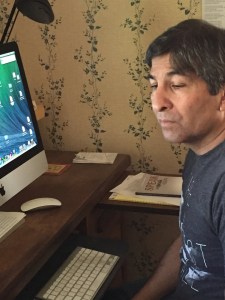
Steve Gutierrez, Pact Press author
Pact Press sits down with Steve Gutierrez, who offers thoughtful insight on the writing craft and on the duty of writers in a polarized age. Pact Press is very proud to include Steve’s article “Our President-Elect Causes Chest Pains and an ER Visit on Thanksgiving,” in our inaugural anthology.

1. Most writers have day jobs and frequently have difficulty finding writing time. How do you manage it?
I don’t have a set schedule. I just write when I can, as often as I can—often at night when everything else is done. I have a compulsive personality that needs to get all the daily stuff that can wait out of the way before I can devote myself to writing. I manage it by creating a goal—to get something specific done that day, no matter how big or small the task.
2. How long have you been writing and do you perceive your writing to have evolved in any particular way that you would like to share?

I’ve been writing since I was eighteen but there have been long stretches, like years, when I wasn’t writing, not by choice but because of whatever was going on inside my head that made it impossible. The writing has changed in a lot of ways, from the composition of sentences, their feel and texture, to a leap into more hybrid forms. I don’t respect genre boundaries. I could care less what anybody else thinks about it.
3. What appealed to you about being a part of the Pact Press Speak and Speak Again anthology?
I was pretty upset by the election of Donald Trump, feeling a nascent evil in the air that I do not think was imaginary. He gave the green light to many hateful people and groups, at least psychologically, and that mood of vengefulness permeated the atmosphere. I do believe that our inner states manifest themselves in very real changes in the air, again—in the air came a foul odor of fear and terror. Writing against it helped dispel my feeling of powerlessness—the anthology gave me an opportunity to join with others to cleanse the air or at least add another breeze to it.
4. What do you think is the responsibility of the writer in today’s polarized environment?
It is the same as always, to write truthfully and honestly, but more urgently than ever before. The writer must disavow cant of any kind, even at the cost of alienating himself from his or her accustomed political circles, and spill his or her political guts out. Nobody must be demonized. We all wear horns. We all wear angel wings. Except for the avowed hate groups that are warped. We must write with the idea that the other side is not simple but variegated and composed of very intelligent people who can listen to reason and passionately expressed argument. We must be alive on the page in a way that is intelligible to opposing factions. We must be more human than ever, admitting our own prejudices and blindness.

5. What would you say to those who can’t understand why Trump has so many Latino supporters?
The so-called Latino community is much more diverse and split than the media would have it. There is a great divide between people who have been here for generations but in some way identify as Latino and those newly arrived immigrants and their children. It’s real simple. Many Latinos are Americans first and possess the same fears as other Americans about heavy immigration, particularly illegal immigration, and the browning of America. Skin color doesn’t matter much or necessarily mean anything. The question of where you stand has to do with culture. Many Spanish-surname Americans or last-generation true Latinos, you might say, are not comfortable with the rapidity with which society has become más Latino. They don’t even speak Spanish. They like Trump’s idea of a wall because they feel overwhelmed by illegal immigration. They do not like America changing in the direction of a culture that is not properly speaking theirs, or not theirs in any real way.

Filed Under: Regal House Titles Tagged With: Pact Press Anthologies, Speak and Speak Again, Steve Gutierrez, Writing Times

Writing Times with Mikhal Weiner

July 12, 2017 Leave a Comment

Pact Press author Mikhal Weiner
Mikhal Weiner

Most writers have day jobs and frequently have difficulty finding writing time. How do you manage it?

Finding time for writing is a huge challenge for me. I have a day job, as do most, and am also a musician, which basically means that I’m constantly trying to maintain three careers at once. Needless to say, this requires a lot of drafting and redrafting of lists. Usually there are two things that help me make sure I make time to write. The first is a project I feel passionate about. This anthology is an excellent example of something that felt extremely important to me, something I didn’t want to miss. The second is a deadline. If I have a hard and fast deadline that’s being imposed by an external source I will absolutely find time to make it happen. In the case of this essay, I had to put in some late nights to get it done, all of which I had scheduled ahead of time. I doubt I would have been so diligent had I not had a hard deadline to meet.

How long have you been writing and do you perceive your writing to have evolved in any particular way that you would like to share?

I’ve been writing for as long as I can remember, but I only decided to write professionally less than a year ago. I think the biggest difference I can point to since making that decision is a more cohesive voice. Part of the reason I began taking my writing more seriously was because I understood that I had a point of view I wanted to share with others, so I’ve been trying to be diligent about having a cohesive voice as I do so.

What appealed to you about being a part of the Pact Press Speak and Speak Again anthology?

The shock, despair, and uncertainty I felt the morning after the presidential election were profound. I truly didn’t know what to do with myself, wandering the streets of New York and looking for a way to explain what was happening to me, my friends, my values, and my country. When my editor from Entropy Magazine sent me this writing opportunity I was immediately interested. I’ve always processed my thoughts and emotions through either my music or my writing and this was a perfect opportunity to work through my confused ideas.

What do you think is the responsibility of the writer in today’s polarized environment?

I think the responsibility of the artist is always the same – to express thoughts and ideas that provoke others out of complacency and into critical thought. As long as there has been society there have been ills in need of our attention, and it’s our lot to point to them, and to encourage others to point to them as well until we’ve come together to create a lasting solution. The artist needs to have an opinion and to express it clearly. Often this is an uncomfortable space to occupy but it’s how societies move forwards – by sharing ideas.

Connect with Mikhal:

Website

Facebook

Tumblr

Filed Under: Pact Press Titles Tagged With: Mikhal Weiner, Pact Press Anthologies, Speak and Speak Again

Pim Wiersinga and Rotterdam’s Literary Scene

May 21, 2017 4 Comments

Regal House author Pim WiersingaAs one of the participating authors (and organizers), I am proud to present:
CALL010

Chambres d’Amis Litteraire – Boulevard Rotterdam on Sunday 21 May, 2017, IETY café, 13.00 – 18.00 hrs

(In remembrance of Jan Hoet, curator in Ghent (1936-2014), who invented the concept.)

People need more art: without empathy and our imaginative faculties we are doomed to lose touch with our inexorable differences in the complex world of 2050. Says the Dutch Social and Cultural Planning Bureau.

CALL010 (010 being the Rotterdam area code) anticipates a future that’s artistic and grounded in physical space: In 2017, on May 21st, writers, musicians, and visual artists will perform in private homes now briefly open to the public, located in the Boulevard area.

During the afternoon, art aficionados push doorbells they never touched, enter, and then, after a welcome…a poet might take the floor, a saxophonist, or both. Half an hour has passed in the blink of an eye; then back on your feet again, moving on. Another doorbell. Different drinks, hosts, and artists, immersing you in a whole new universe. A singer-songwriter, a poet trying her hand at a short story, a visual artist, a fellow soul. Meet people you have never met before!

Poetry posters are on display behind various windows on ground floors.

A book (50 pages) will be for sale (at IETY café, the start & finish of the festival; price €10) containing authors’ texts, artist’s images, and a well-researched historical take on the Boulevard area––built in the 1900’s to keep industrial tycoons from moving out of town. Upon purchase, a Polaroid will be shot: you with your favourite author, stuck in the back of the book!

Pim Wiersinga and fellow novelist Bianca Boer will perform at Heemraadssingel 329, in the port of Rotterdam.

Wiersinga wrote several novels, including historical fiction. In 2017, he made his debut in English with a high profile ‘thriller-in-letters’, The Pavilion of Forgotten Concubines, set in late 18th century China.

Learn more at https://regalhousepublishing.com/pimwiersinga/ and http://pimwiersinga.nl/pavilion/

Filed Under: Regal House Titles Tagged With: literary event, pavilion of forgotten concubines, pim wiersinga, Rotterdam

Writing Times with Lily Iona MacKenzie

May 15, 2017 Leave a Comment

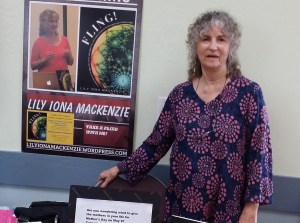
Lily Iona MacKenzieMost writers have day jobs and frequently have difficulty finding writing time. How do you manage it?


For me, it isn’t a matter of managing it. Writing is as essential to me as eating, so I must find time to write each day. I’ve discovered, amidst teaching writing part time at the University of San Francisco (USF) and other colleges , helping to raise two stepchildren, serving as vice president of USF’s part-time faculty union, and other responsibilities, that if I write a minimum of one hour a day, I can accomplish a lot!

How long have you been writing and do you perceive your writing to have evolved in any particular way that you would like to share?

I took on writing seriously in my late twenties. I started out focusing on poetry, and it still forms the foundation for my work. But I also am interested in short and long fiction, having written four+ novels and numerous short stories. I also love writing essays, from travel writing to book reviews, to critical essay

What appealed to you about being a part of the Pact Press Speak and Speak Again anthology?

Having grown up in Canada, a country that embraces social justice, I moved to America in 1963 eager to support the Civil Rights Movement, as well as the feminists who were addressing all the inequalities women and others had suffered for centuries. Participating in this anthology seems a natural outcome of my life-long interest in pushing for a just society.

What do you think is the responsibility of the writer in today’s polarized environment?

When I write, I don’t think about the polarized environment I live in. In fact, I never think about audience. As a writer, I try to dive below the social surface and capture some truth about what it means to be human. I don’t write for a particular audience or movement or particular ideology. I write to generate poetry, fiction, etc., that originates deep within myself and resonates with readers no matter what their backgrounds may be.

Do you think that self-revelation is part of the writing process?

I don’t think we can be serious writers without undressing completely, externally and internally, in our works. How else can we explore the vastness of life and its many dimensions? While we may be inventing characters and situations, fragments of our selves can’t help but be embedded in our work.  Some writers are more autobiographical than others and therefore more revealing in that sense. But even in my novel Curva Peligrosa, to be released in 2017, which is not at all autobiographical, I reveal myself in the ideas I explore there. I am not at all like the amoral main character, Curva Peligrosa, but I do share some of her attitudes and beliefs. So the autobiographical gets intertwined with the fiction, and a writer can’t avoid being revealed in the process.

Lily Iona MacKenzie, a Bay Area resident who currently teaches memoir writing to older adults at the University of San Francisco’s Fromm Institute, has published poetry, short fiction, and essays in over 150 Canadian and American publications. Her poetry collection All This was published in October 2011. Novels: Fling! was published in July 2015. Curva Peligrosa will be published in 2017. Freefall: A Divine Comedy will be released in 2018.

Connect with Lily:

Website

Facebook

Twitter

Filed Under: Regal House Titles Tagged With: Curva Peligrosa, Lily Iona MacKenzie, Pact Press Anthologies, Speak and Speak Again

Writing Times with Frances Kai-Hwa Wang

May 12, 2017 Leave a Comment

Pact Press author Frances Kai-Hwa Wang

Most writers have day jobs and frequently have difficulty finding writing time. How do you manage it?

I have four children and nine jobs. I manage it by not sleeping. Ever.

How long have you been writing and do you perceive your writing to have evolved in any particular way that you would like to share?

I have been writing since fifth grade when I wrote a book review of “Old Bones” for Highlights Magazine. I did it for the money, $5. Since then, I have written news, feature articles, reviews, essays, columns, blog posts, prose poetry, and creative nonfiction, primarily for ethnic new media. I have also created multimedia artworks and I have hand sewn chapbooks. I speak often to college students and young professionals about Asian American history and media, challenging them to resistance and action. Regardless of the form, I find that I am always searching for meaning, for truth, for better understanding. My guardian angel once observed, “You’re the sort of person who doesn’t even know what you think until you’ve written it.”

What appealed to you about being a part of the Pact Press Speak and Speak Again anthology?

I love the Southern Poverty Law Center, Teaching Tolerance, and all the great work that they do!

What do you think is the responsibility of the writer in today’s polarized environment?

Make trouble. Move hearts. Incite people to action. #GoodTrouble

 Why do you do write? Why do you do what you do?

I really want to help empower younger Asian Americans and Pacific Islanders so that they do not have to go through the same stuff we did with identity crises, being a minority, always being “the only one.” I would love to spare people (starting with my own children) the angst of wrestling with who they are, what they are, how they fit in, and help them develop a strong sense of identity, culture, and pride. I advocate and speak up for the older generation and more recent immigrants who might not have the education, political awareness, or English skills to fight for their rights and their children’s rights. I talk to the mainstream because I figure that the best way to protect my children from racism and discrimination tomorrow is to educate their peers today.


Frances Kai-Hwa Wang is a second-generation Chinese American from California who now divides her time between Michigan and Hawai‘i. She is a contributor and essayist for NBC News Asian America. She has also written for AAPIVoices.com, NewAmericaMedia.org, ChicagoIsTheWorld.org, AnnArbor.com, PacificCitizen.org, InCultureParent.com. She teaches Asian/Pacific Islander American Studies at University of Michigan. She has published three chapbooks of prose poetry, been included in several anthologies and art exhibitions, and created a collaborative multimedia artwork for a Smithsonian Asian Pacific American Center.

Frances has three chapbooks available from Blacklava Books

Imaginary Affairs—Postcards from an Imagined Life

Where the Lava Meets the Sea–Asian Pacific American Postcards from Hawai‘i

Dreams of the Diaspora

Connect with Frances:

 Website

TWITTER

FACEBOOK

Filed Under: Pact Press Titles Tagged With: Frances Kai-Hwa Wang, Pact Press, Pact Press Anthologies

Writing Times with Daniel A. Olivas

May 11, 2017 1 Comment

Daniel A. Olivas, Pact Press author
Daniel A. Olivas lives in Los Angeles with his wife. By day, he is an attorney.

Pact Press sits down with Daniel A. Olivas, who offers thoughtful insight on the writing craft and on the duty of writers in a polarized age, with a inspiring message for emerging writers. Pact Press is very proud to be releasing Daniel A. Olivas’ poetry collection, Crossing the Border, in the fall of this year.

  • Most writers have day jobs and frequently have difficulty finding writing time. How do you manage it?

First, I have a very patient spouse who understands my artistic compulsion to write.  Second, I am a compulsive writer.  Third, I derive great joy from creative writing.

  • How long have you been writing and do you perceive your writing to have evolved in any particular way that you would like to share?

I’ve been writing since I learned how to spell out words.  My mother saved some of my very early little books that I wrote…simple stories with illustrations.  I wrote all through school but put aside creative writing when I went to law school and started my legal career.  But even as a lawyer, I wrote constantly: briefs, memos, letters.  I also wrote articles for our legal newspaper here in Los Angeles.  Then at the ripe old age of 39, I started to write fiction and poetry which started to get published.  Now, 19 years later and almost a dozen books to my name along with critical and scholarly recognition of my writing, I’m still in love with the creative process.  In terms of my evolution as a writer, I believe that my stories and poetry are deeper yet more economical.

  • What appealed to you about being a part of the Pact Press Speak and Speak Again anthology?

With the election of Trump, we’ve entered into a very dangerous time in our history.  I feel as though I have a duty to be part of the literary resistance movement.  I will not sit back quietly.  I believe Speak and Speak Again is part of that movement.

  • What do you think is the responsibility of the writer in today’s polarized environment?

As a writer of color, as a Chicano writer, I feel as though I have a duty to speak out in favor of diversity, civil rights, and justice especially during these perilous political times.  Also, I believe that when a person of color gets published, that—by itself—is a political act.  As I often tell students when I get a chance to speak in front of them: if we don’t write our own stories, someone else will, and they will get it wrong.

  • What advice would you offer writers who are just embarking on their careers?

Work hard, read a lot, and don’t let anyone tell you that your voice is not important.

Connect with Daniel:
 TWITTER
 WEBSITE
Daniel’s published work may be ordered through your local bookstore, online, or through the publishers:

The King of Lighting Fixtures: Stories (University of Arizona Press, 2017)

Crossing the Border: Collected Poems (Pact Press, 2017)

The Coiled Serpent: Poets Arising from the Cultural Quakes and Shifts of Los Angeles (Tía Chucha Press, 2016)

Things We Do Not Talk About: Exploring Latino/a Literature through Essays and Interviews (San Diego State University Press, 2014)

The Book of Want: A Novel (University of Arizona Press, 2011)

Anywhere But L.A.: Stories (Bilingual Press, 2009)

Latinos in Lotusland (Bilingual Press, 2008)

Benjamin and the Word (Arte Público Press, 2005)

Devil Talk: Stories (Bilingual Press, 2004)

Assumption and Other Stories (Bilingual Press, 2003)

Filed Under: Pact Press Titles Tagged With: Daniel A. Olivas, Pact Press Anthologies, poetry, Speak and Speak Again

  • « Go to Previous Page
  • Page 1
  • Interim pages omitted …
  • Page 9
  • Page 10
  • Page 11
  • Page 12
  • Go to Next Page »

Footer

The Regal House Enterprise

Regal House Publishing is the parent company to the following imprints:

Fitzroy Books publishing finely crafted MG, YA and NA fiction.

Pact Press publishing finely crafted anthologies and full-length works that focus upon issues such as diversity, immigration, racism and discrimination.

The Regal House Initiative, a 501(c)(3) nonprofit that conducts project-based literacy and educational outreach in support of underserved communities.

From our Blog

Dockside Books: An Up North Haven for Thinkers, Adventurers, and Creatives

Tombolo Books: a book lover’s loveshack in downtown St. Pete, Florida

That’s My Story: Regal House Publishing (RHP) Interviews Novelist James Janko

  • Facebook
  • Twitter
  • LinkedIn
  • Google +
  • Email
Regal House Publishing · © 2017–2025 · Website design by Lafayette & Greene
 

Loading Comments...