- The stories in your new book World Gone Missing all explore a central theme: that people don’t become fully visible until they disappear. What brought that theme about?
The truth is I didn’t pick that theme as much as it picked me. Before I even had a thought of a book in my brain, my brother-in-law went missing. Decades later, sadly he still hasn’t reappeared. Though the opening story in World Gone Missing—“Bigger Than Life”—has a similar through-line, I completely fictionalized the characters and specific plot points. What remains true to life is the feeling you get when a loved one seems to vanish into thin air. The best way I can describe it is a sinking, helpless sensation. As the years wore on, I began to see my brother-in-law in new ways. I appreciated his subtle kindnesses and sharp wit, along with his sometimes brash and irrational nature. Thought I’m not sure this would have changed anything, I wish I could have been more compassionate.
As I finished this story and embarked on others, I realized that losing a loved one can bring many conflicted feelings, and conflict is at the heart of fiction. Sometimes a person’s absence can free up a character to do things they’d never done before, wonderful things. Sometimes they find it almost impossible to move on. This realization got me going and I saw both the loss and liberation that absence can bring. Though I had to get a chunk of stories written before that unifying theme floated up.
- Why a book of stories, and not a novel?
Jim Shepard, winner of the Rea Award for the Short Story and many other honors, likes to joke that he writes short fiction “for the money.” The reality is it is harder to publish a collection than a novel, because collections don’t sell as well. I feel lucky that Regal House Publishing picked up my book. But I’ve talked to a ton of readers who live and breathe short stories. But given the economics of short fiction, does that mean the short story is a lesser art? There are certainly professors and authors who view stories as “practice” before the writer settles down to create what truly matters in the world of literature: the novel.
I could not disagree more.
To me, it makes absolutely no sense to pit short and long fiction in competition against one another. Both forms are art. I love the way I can hold a story in my head, relishing all its details right up to the ending. I also love immersing myself in the vast world of a novel, though I often have to reorient myself when I pick up the book to read more. Short stories have been made into more award-winning movies than most people realize, including Broke Back Mountain (Annie Proulx), The Birds (Daphne du Maurier), Breakfast at Tiffany’s (Truman Capote). The world needs short and long fiction.
In terms of my own writing, here again, I’d have to say the short story choose me, rather than me it. A while back, I got introduced to the magic of Alice Munro, then the bounty of Best American Short Stories. I started faithfully reading stories everywhere I could find them. At some point, I thought, why the hell not — why not try my hand at writing short fiction? After a decade of work—most authors say writing a story collection is just as hard as a novel—World Gone Missing is now out in the world. It’s quite a feeling.
- I understand you teach writing at UC Berkeley Extension. How does teaching affect your writing?
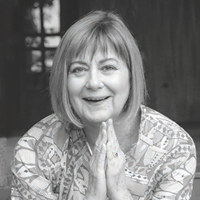 Teaching writing has given me many gifts. Maybe that sounds corny, but it’s true. Teaching requires that I make a deep study of masterful writing. In fact, the first writing class I taught was “Learning From the Masters: Techniques of the Literary Greats.” Of course, I had studied renowned authors in grad school, but now I had to go deeper. To prepare for the class, I examined how Hemingway constructed his dialogue so it sounds real, how Baldwin used imagery to create underlying meaning, what Grace Paley does to make us laugh. In identifying specific techniques and articulating for students what they accomplish, I have learned a tremendous amount. Ten years later, I’m still teaching the “Learning From the Masters” course and it continues to feel fresh.
I find the dedication and inventiveness of my students inspiring. I’ve taught many talented student-writers over the years, from twenty-somethings to eighty-somethings. Their precise language, unique voice, and original plot lines amaze me. The way students solve common writing challenges—for example, how to immediately plunge the reader into the story, or use suspense—often gets me thinking in new ways. After class, though I’m usually pretty tired, I find myself scribbling down my own ideas to expand on the next morning.
- Can you describe the process of writing “World Gone Missing?” How long did it take you to write your book?
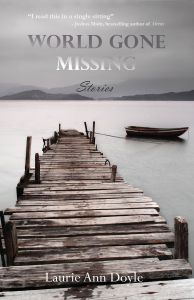 Writing World Gone Missing took me a decade. During that time, I was also transitioning out of healthcare, teaching writing, and raising a son. As importantly, I was developing the intellectual and artistic autonomy that every writer needs to write the best words in the best way they can. The book formed slowly, like a Polaroid photograph coming into focus. Over that decade, I also started and put aside a novel, began a story collection based in the Arizona high desert, and penned and published several short memoir pieces. But time and time again I kept returning to the fledging group of stories that ultimately became World Gone Missing. The book is a collection of twelve pieces all set in the San Francisco Bay Area and linked by the overarching theme that people don’t become fully visible until they disappear. It’s an odd and interesting conundrum.
But I didn’t realize that I had a book-length work until I was about five or six stories in. The first story I wrote for the collection, “Voices,” was initially drafted in grad school. The last story, “Lilacs and Formaldehyde,” was finished just a few months before the book’s final edits, after I’d decided the book needed a bit of magical realism.
What drove much of World Gone Missing were memories of places in the Bay Area that rose in my brain when I least expected them: the historic carousel in Golden Gate Park where my grandmother loved to take us, the Victory Statue in the center of Union Square, the pastel-colored homes across from Highland General Hospital, and the smashed shop windows on Telegraph Avenue that I saw one October morning after I first arrived at UC Berkeley as a freshman. All these details showed up in World Gone Missing
- What’s next for you, writing wise?
I’ve finished up several flash fiction pieces, which was enjoyable. Now I’m deep into novel, which takes place (of course) in Northern California. Though I don’t want to give too much away, it continues my emphasis on characters who are missing from the present action, as well as illuminating the intimate connections between people and place, whether they be a shadowy forest, an immense lake, or simply a specific stretch of patched sidewalk. Details of the physical story world always pull me forward.

Laurie Ann Doyle is an award-winning writer and teacher of writing. Stories in Laurie’s debut collection, World Gone Missing, have won the Alligator Juniper National Fiction Award, been nominated for Best New American Voices and the Pushcart Prize. Her stories and essays have also been published in The Los Angeles Review, Timber, Jabberwork Review, Under the Sun, and elsewhere.
 What do you read that people wouldn’t expect you to read?
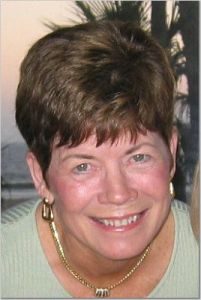 Anything that helps us to understand and connect with others is important, and learning other languages is most definitely a window into other people and different cultures. The way we express ourselves in our languages is hardwired into our brains, and if we can speak other languages, we can have insights into the thought processes of other people that we otherwise wouldn’t have. I loved writing Secrets in Translation, because I could use my Italian, which I began speaking when I grew up in Southern Italy as a little girl. It made me feel at home again! I speak other languages, as well, but Italian is the language of my heart.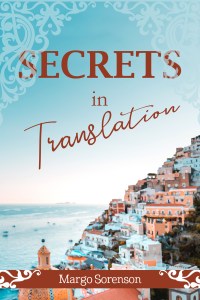

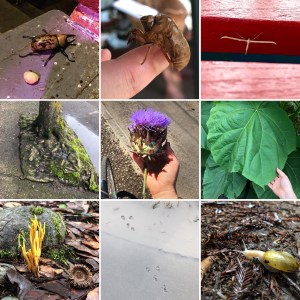 There’s something to be said for pairing excessive attention to detail in real life with the ridiculousness of imaginary trajectories. Most days, I notice a lot of inconsequential stuff and catalog it away (today, it was a line of ants fighting along the crack in a sidewalk). Writing about them gives me a release of all of these relatively unimportant details that follow me around (strangely, people are willing to read about ants, but no one in real life is really wants to talk about them). These details get dropped into scenes to add a bit of grounding to scenes, both for the reader and in my own mind. As I edit and revise, that’s where my imagination kicks in and adds the details I don’t recall or the things that should have or could have happened. Then later, when I think back on the actual event, I…uh, I sometimes can’t remember what was real and what I made up.
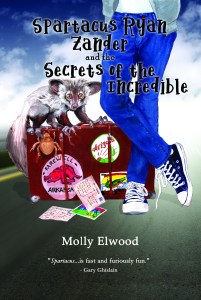 For example, in Spartacus Ryan Zander and the Secrets of the Incredible, I include a scene where there’s a rat stuck in a crack in the cement. I recall in real life, walking to brunch and coming across a rat in a crack. It was horrible. There was nothing we could do. Later, we passed it again and it was gone. A cat? A good Samaritan? I have no clue. But I went home and wrote it into my book and it became one of my favorite scenes. In that scene, the rat is very much alive. However, to this day, neither my husband nor I can agree whether our rat was alive when we passed it the first time. I insist it had to have been still and playing dead—if it were alive, I would have done everything possible to get it out. Even hunt down some reverse lion pliers.
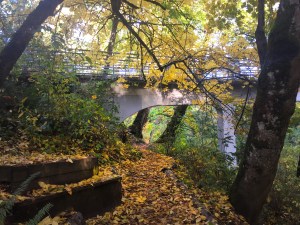 One of the strangest way this manifests itself is this weird auditory/location memory, where I can pair something I heard with where I heard it (and vice versa). Right now, on my jogging loop, every time I pass under the walking bridge, lines from the Modern Love podcast I listed to under it echo through my mind. Someday, I will harness this skill and maybe learn Italian—which I’ll only be able to speak in the park where I listened to language tapes.
 Plus, I think there is also a confidence that comes with being an adult and reading something meant for a younger audience—you’re getting to go back to your own happier times, but with the wisdom of your experience. It’s rewarding to read about a stressful teen experience and think you’d be capable of handling it. 😉


 How do you think translation affects a story?