by Nora Shychuk
 Like so many others, I had moved to New York City with a dream to write, to be at the center of things and pay attention. But such a reality, even in the service of a great dream, is a hard and often lonely one. I knew it wouldn’t be an easy move to make, but I’d be lying if I said it wasn’t harder than I guessed it would be. I was out of my element and struggling to find my place. I knew very few people. To say that I was overwhelmed and scared on a daily basis would be an understatement.
I remember, just twenty-four hours before, feeling completely exposed walking through Times Square. Peddlers tried to sell me tickets to comedy shows and shoved CDs in my hands. The rumble of the subway underneath my feet was jolting, the perpetual traffic and honking became its own temperamental rhythm. I felt as if I was on another planet.
But the West Village is, comparatively, quiet. It was an early October afternoon. The sun shined, the blue sky above was soft and cloudless. As I walked, people were few and far between. I could hear my footsteps and birds in the trees. Colorful leaves blew across the cozy streets, drawing my eyes to the red brick buildings as I made my way to Bank Street.
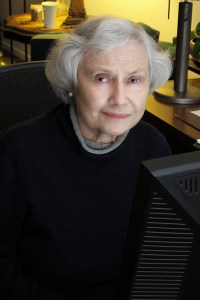 I had an appointment. I was set to interview Carol Hebald, author of the novel A Warsaw Chronicle. We had exchanged e-mails for months, setting up a time and place to meet to discuss her new book. As a young, emerging writer just having arrived in the cultural, literary hub of the world, the chance to sit down with a seasoned writer and lifelong New Yorker struck me as a great professional opportunity.
And I suppose it was. But it was so much more than that.
When I arrived, Carol had food ready and waiting on the table. After a warm welcome, she asked if I’d like coffee, tea, or wine. Having to work later that afternoon, I passed on the wine and opted for coffee. While she got it ready, we talked about New York and my recent year and a half abroad in Ireland where I earned my graduate degree.
“Do you miss it?” she asked me.
She smiled easily and when I spoke her eye contact was unwavering. She was a woman – and writer – who knew how to listen. I felt at home immediately.
“Yes,” I said. “I really do.”
When my coffee was ready, I walked it to the living room where Carol and I both sat down on her couch at opposite ends.
A Warsaw Chronicle follows Karolina Heybald, an American exchange professor teaching at Warsaw University during the inception of martial law in 1981. Always present in the novel is the conflict between the Communist party and the Solidarity movement. Karolina finds herself in the midst of political turmoil as she tries to find a missing cousin. Everywhere she looks, there is danger, real and unavoidable.
Carol and I started the interview by looking back. Amazingly, A Warsaw Chronicle was inspired by very true events. From 1981 to 1982, Carol was the visiting American exchange professor at Warsaw University in Poland. She had just received tenure as an associate professor at the University of Kansas but jumped at the opportunity to go abroad.
She explained that at the time, Poland was behind the Iron Curtain. Politically, it was divisive and violent. Many people asked her why she’d ever want to travel to Warsaw. She was doing well professionally. Didn’t she know the risks? But her reasons were never professional. They were personal and close to the heart.
Her father was born in Krakow and died when Carol was only four. To go to the country where he was born presented her with an opportunity for closure. Not to mention, she saw it as an opportunity to challenge herself.
“I was very naïve in many, many ways,” Carol told me. “Two classes and a handful of students in each. I’d have a world of time to write, I thought, [but] I was in something of a shock when I got there.”
When she arrived in Warsaw, it was sunny and clear. “People looked at me as though I was crazy because they were having such a difficult time,” she said. “It was only two or three months before martial law was declared and I didn’t realize what was happening politically. They kept saying, ‘why did you come here? Why did you come here? Nobody wants to come here.’”
She recalled waiting in long lines for food and how there was never enough to eat. She went hungry herself, a feature common in A Warsaw Chronicle.
Some of the characters in the novel are drawn from life. Karolina’s tutor, for example, is real. When Carol arrived in Warsaw she met him immediately. The two are still in touch today.
Another driving force in A Warsaw Chronicle is Marek, Karolina’s star pupil who dreams of becoming a poet. Their connection entangles Karolina in a high-stakes conflict concerning Marek’s fate. The relationship between the two is fully formed, fully realized. But, Carol told me, Marek is complete fiction.
“I shouldn’t say complete,” she clarified. “There was a meeting somewhere around November right before martial law was declared when a student raised his hand and asked a question I remember having at his age. [He asked] about great work. Does it come from a great idleness or does it come from an enormous amount of work. Which was true? And I just remembered that I had asked that question myself. I looked at him and his face remained in my mind. I never saw him again, but he became Marek.”
Carol went on to say that she felt the closest to Marek, that his character was the most her. He developed organically, as all her characters do. Instead of planning and plotting, Carol allows the moving pieces and voices of her novels to develop naturally, to come to her when the time is right. “[Marek] became a character who was very much alive. And my part was already there. And then I created the father. I don’t know from where. I didn’t consciously sit down and decide to write what I wrote.”
The father, first Lieutenant Maciesz, is a ruthless presence in A Warsaw Chronicle. But, Carol said, he’s a part of her, too. “They come out of me. The father. His cruelty, his bitterness, the fault in his thinking that because he has suffered so much, he knows more.”
The novel developed from old journal entries Carol wrote during her time abroad. Every day, she was chronicling observations about life in Poland. “I simply made diary entries every day and the story took off on its own.”
I told Carol I worked much the same way, going off of notes, feelings, and observations rather than outlining down to the very last detail. I told her I barely ever made a conscious decision in terms of pace or what’s best, practically, for plot. Instead, I go with my gut and allow a certain emotional tug to sway me. I let the ideas grow as I work.
“Yes,” she said. “You have to listen. You have to have the confidence. If someone tells me, for example, in the writer’s group, that they lost interest in a certain moment, I’d be interested in that because there is, in a novel, necessary places where you want to insert certain information and want the reader to be bored. You don’t want to get rid of too much of [the reader’s] energy. You’re writing and listening at the same time and you’re saying ‘I’ve had enough of this and want to get back to the action.’”
And only the writer knows their characters and how they must navigate through life as the story develops. For Carol, it can’t be all gunfights and obsessive love triangles. Writing is about life, and that includes the mundane, the slow, quiet moments of the every day. “Deep down,” she said, “you know when a moment should drag. It lets the reader rest so they have the energy to feel more when the next crisis comes along.”
It was easy to talk about the process of writing with Carol, about the importance of feeling a story and understanding our characters and where they come from. Personal experience always helps, too. For her, A Warsaw Chronicle was always waiting to be told. It formed from isolation and the reality of displacement. “It was the loneliness that I felt,” she said. “There was very little teaching that went on there. It was mostly waiting in line for food. It was mostly waiting for the day to end.”
But she remembered her time in Kansas and knew that her reason to leave was warranted. “It certainly didn’t do me any good professionally, but Kansas was more of a foreign country to me than Warsaw could ever be. I was a lot lonelier in Kansas than I was in Warsaw. I’m from New York City. Born and bred. And Warsaw was another city, at least. And my father was from there; I wanted to explore where he lived. I wanted to forget him – that was the central thing in my life because he was so much a part of me.”
 At this point in our conversation, Carol stopped and looked far off. I followed her line of sight. She was looking out the window, at the streams of autumnal light. Whatever she said next would be carefully considered. She took a deep breath.
“This is hard to explain,” she said. “He was on my mind all the time. He died when I was four years old. And I wanted that to end. I thought if I went I could put it all behind me and just get on with my life as a woman, you know? I was nearly 50 at the time.”
I spoke openly about my own readiness to go abroad to Ireland two years prior. Of course, Ireland was much safer and free of any comparable political upheaval, but it was still a drastic move that few people I knew had ever taken. I wanted to get out of Florida and away from the people I never understood. I told Carol that, quite similarly, I felt the need to leave in order to understand something larger. I moved four-thousand miles away and felt immediately more rooted. I felt like a better version of myself.
I spoke of my own mother next. She died of lung cancer when I was ten. Carol’s father had also died of cancer. We both knew the pain of untimely death, of lives cut short. When such a loss disrupts your life, it’s not hard to understand the simple but heartbreaking fact that life doesn’t last forever. We’re not guaranteed long, happy existences. It was clear to both of us, in the quiet way in which we remembered them, that our parents passing away triggered something in us: the need to make our days count.
“My mom is in everything I write,” I told Carol. “It’s interesting, the loss of a parent. There’s so much you don’t know, but it still impacts so much of what you do.”
“Everything,” she said. “When I was three I was alone in the house with him. My mother took over the store, my sister was in school. There was a nurse taking care of me, but we were alone for an entire year. My dad and I. And even though I don’t know remember all the details of that year, it’s a central part of my life. I remember, shortly before he died, I asked my father what I should be when I grow up. He told me to be somebody.”
In 1984, after she returned from Poland, Carol resigned her tenure and moved back to New York City to write full-time. I told her that a lot of people would consider such a move reckless, to give up comfort for a life of instability and uncertainty. But Carol knew what it was like to struggle and scrape by. Poland proved that to her. She wasn’t afraid of being poor or of struggling all over again. As long as she was doing what she wanted to do, it was worth it.
“When I was in Brooklyn I was writing full-time in a little room which was about $275 a month, so you can imagine it was in the middle of nowhere. But that’s all I wanted, that room to write. If I wrote well I felt well.”
She paused and smiled again, remembering. “It was my whole life.”
“And what did you learn from devoting your life to writing?” I asked next.
I expected an answer that is heard quite often. A mixture of “never give up on your dreams” and the value of hard work, the earned freedom of going after what you love and want to do. That worthwhile joy of a life spent seeing, feeling, and experiencing. But Carol’s answer was surprisingly refreshing and true: she learned nothing.
“I’ve learned nothing, except that books make books, not experience, not human relationships. Books. And that’s the same advice I’d give anybody who was just starting out: Read! Read! Don’t stop reading! Read what you hate, read what you love. Decide why you love it, how you can borrow from the structure of a novel. You’re not doing anything but borrowing a way to tell a story. You’re trying to learn to tell a story.”
You’re not doing anything but learning to tell a story. Yes, that’s nothing—but everything all at once. By learning to write, you’re learning about yourself.
A Warsaw Chronicle is available from Regal House Publishing.
PART II, to be posted forthwith.

Nora Shychuk has an M.A. in Creative Writing from University College Cork and a B.A. in Film Screenwriting and English from Jacksonville University. Her writing has appeared in The Lonely Crowd, The Quarryman Literary Journal, The Rose Magazine, and Pact Press’s Speak and Speak Again Anthology. In 2017 she was shortlisted for Cork, Ireland’s From The Well Short Story Competition and was also awarded one of two full Alumni Awards to attend the Iceland Writers Retreat (IWR) in April 2018. She lives in New York City.

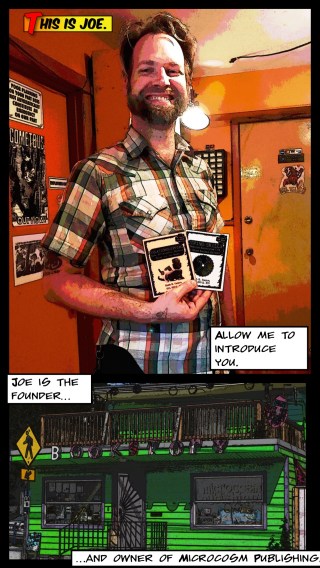



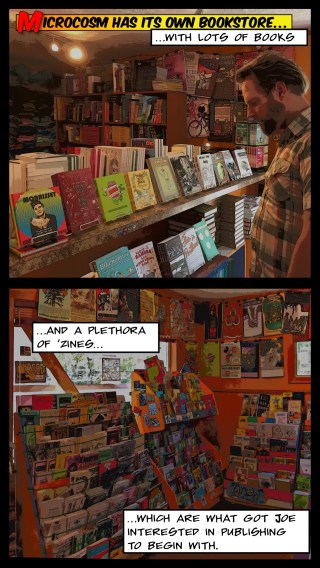









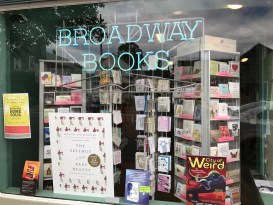 The store-front windows of Broadway Books make the shop light and airy, and its well-organized shelves draw customers on to explore the next book, the next topic, the next table. Over the shelves hang poster-sized covers of other volumes for which readers might want to search.
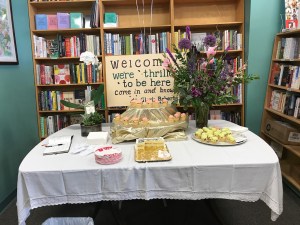 The birthday party on Saturday made it obvious what a community asset the store is. I met a trio of women who had been friends for forty years. Regular customers milled about, chatting, talking books with the owners and staff, having their photos taken at the picture booth set up for the day, and eating cake and drinking champagne. Despite the bustle of the celebration, I saw the staff continuously assisting customers by making recommendations and finding books. One of the owners (alas! I did not discover which one) asked everyone there to please go out and tell the story of their book store, and I am happy to comply with that request here.
 I began my bookstore safari in Seattle, Washington, where I was visiting my particular friend Maren Donley. Before I arrived, I explained my quest to her, and she immediately recommended a visit to the Third Place Books. While there are three Third Places (I’m not sure how the math works on that, whether it requires simple addition or some kind of quantum exponential multiplication), Maren suggested we drop by the Lake Forest store. “I drive by it twice a week. I had never been in until I met my priest there for a meeting. Then I said, ‘Oh! I have really been missing out!'” she told me.
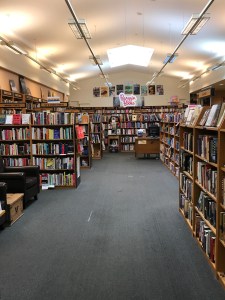
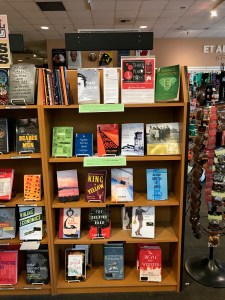 The selection of books, Mr. Sindelar told me, has a curatorial aspect. The staff have a lot of say in the choices, which are also guided by the interests of customers and the diverse ideas and opinions that represent the neighborhood. It seems that every aspect of Third Place is indeed geared toward fostering community and neighborhood. The Commons area not only has ample seating and a play area for small children, it has three restaurants as well: sustenance for both mind and body.
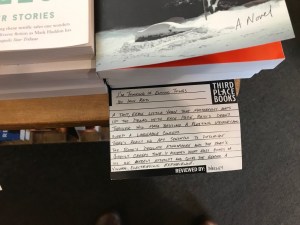 As we wended our way toward the registers at the front of the store, Maren pointed out the cards that annotated the books on the tables and shelves. The cards offered reviews by the staff, noted awards won by the book and author, and even let browsers know that a less expensive edition of the book in question was available on a different shelf in the store. I had seen cards similarly deployed in other stores, but never to such good effect. Walking through the store while looking at the books and reading the cards was like enjoying a stimulating conversation with friends or taking part in a silent book club discussion.
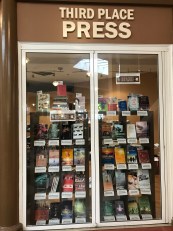

 Bookstores, for me, have always been imbued with magic: their exterior signage, the glimpse of books and bindings through gleaming glass windows sound a magnet call that I am utterly helpless to resist. It little matters whether the bookshop is a dusty repository of the previously loved or a modern facility that houses the recently released, but it must be independent—chains necessarily lack the vibrant individuality that differentiates one store from the other.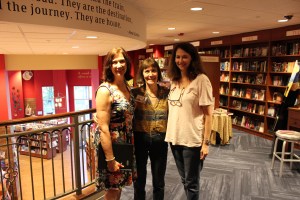
 When one first walks through the doors at Quail Ridge Books, however—child and adult alike—the immediate impression is one of space, modern and convivial. It can be challenging indeed to marry the two: large can be lacking intimacy, modernity can be at the expense of warmth. And, for bookstores, the challenge doesn’t end there: one must, after all, pack in the shelving that allows for ready browsing, with aisle space for fellow booklovers to exchange a smile or two, so that one can peruse the spines from a little distance without feeling confined and hemmed in. Quail Ridge Books navigates these potential pitfalls masterfully. The walls are a warmly inviting shade of maroon, chandeliers add a decadent luxury to the browsing space, and the chairs—Oh, an entire blog post could be written on the chairs alone! They are upholstered in bright fabrics, with cushions deep and snug. And you realize, as you sink into one with books on your lap, that you are indeed welcome to stay and leaf through some favorite selections. For Quail Ridge Books is not about lining customers up, extracting from them their book-purchasing funds, and getting them out the door to make room for the new and next buyer. Quail Ridge Books, the store and the staff, are imbued with a passionate love of books and of sharing that passion with the Raleigh world. This dedication meant that the chair choice was no small matter. As Lisa, the owner of Quail Ridge Books, noted: “I have three daughters and when they were growing up, they always wanted to go to bookstores and sit in comfy seats. Not all bookstores have comfy seats, or any seats at all, so that was important: lots of comfy seats.” And so it occurs to me that Quail Ridge Books is like the Victorian library that we all wish we had at home with the winged back chair in front of the fireplace, innumerable books all around. Quail Ridge Books has one such library—and they are inviting us all in!

