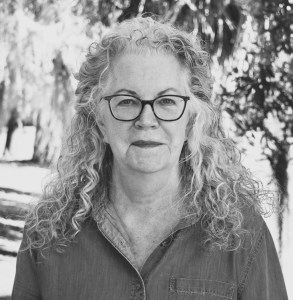
Like many writers, I started with books – other writers’ books. A perceptive elementary school teacher understood that an unraised hand might have nothing to do with knowing an answer and asked me to help her in the library after school. There, in a room no larger than a two-car garage, I shelved books, taped spines and torn pages. In return, she offered me The Black Stallion, Misty of Chincoteague, The Yearling…. Books became a refuge for a quiet slip of a girl trying not to be noticed.
Although I started stringing words together and putting them on paper when I was ten or eleven, nothing was shared until eighth grade. (The sole books in our house were a set of World Book Encyclopedias and a stack of sketchy mass market paperbacks hidden in an attic dormer.) It was springtime, the air soft with the odor of dogwood blossoms as we sat around an oval table and one by one read our work aloud. At my turn, I couldn’t control my hands shaking or my voice wobbling, but as I read, I soon thought not of my nails bitten down, my frizzy untamable hair. I thought of the story I had made up and written down with no more authority than the simple fact that I knew the alphabet and had been assigned the task of arranging and duplicating its individual parts into a single piece of creative writing.
When I finished the teacher did not immediately turn to another student, say “next” or “quiet down.” She said nothing. No one did. Then, directly across from me, a girl broke into crying. After the teacher gave her a tissue, the girl honked her nose into it. But no one laughed. Those who remained dry-eyed just stared at me. The teacher called the class to order and asked someone to open the window (fresh air was a cure for so many things back then).
With her imagination, a quiet girl had made something emotional happen to someone else. And the story had not even been true. Off I went.
I went on to formally study poetry then to write fiction and eventually published five works of literary fiction with major, independent, and university presses. My first novel Boondocking, was a Barnes & Nobel Discover Great New Writers pick, and named one of Library Journal’s best first novels. My poems and stories have appeared in literary journals and anthologies across the U.S., and nonfiction travel pieces in The New York Times. All the while I found steady paying work primarily with words, first newspapers and magazines, then in children’s publishing, the last 21 years commuting into Manhattan from a cottage in the woods of CT. Those years I wrote on the train.
In my work I’ve pushed beyond story to test the limits of what a novel can do and be. Father Flashes, which won Fiction Collective’s inaugural Catherine Doctorow Prize for Innovative Fiction, is a novel in vignettes. With The Sixteenth I wanted to explore how viewpoint, given over to a progression of young women through time could reflect on family history as well as history itself–how it’s interpreted and changed by the young.
Regal House Publishing is proud to bring you Tricia Bauer’s The Sixteenth in 2027.


