Winner of the 2025 Petrichor Prize
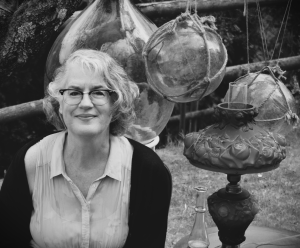
I was born and raised in the Ozark Mountains of Arkansas, where my family goes back for generations beyond memory. So I grew up hearing twangy mountain voices telling all those old stories while I was sitting with my grandmother at the beauty parlour or leaning on the counter at the butcher shop while my mother gossiped with the other ladies. But despite (or because of) being steeped in the oral tradition, I knew I wanted to be a writer pretty much as soon as I knew that such a creature existed and my father’s great gift to me was always to say, whenever we went into any bookstore, “You can have any book you want.”
I left Arkansas when I was 18-years-old to go to Harvard University and found out how to live a life of always being a cultural outsider. I learned to speak like the people around me, but inside my head, I never stopped hearing the backwoods drawl of my upbringing.
I’ve done a lot of things over the years since I left Arkansas — dropped out of Harvard and then eventually dropped back in and got my degree. worked as a short-order cook in an after-hours Boston dive, tended bar in the best underground blues club in North Carolina, had two children on my own, got a Ph.D. in sociology from the University of North Carolina at Chapel Hill, became a professor at Colorado College, lived for a year in a haunted house on a remote island in the South Pacific, married the love of my life, and finally, at long last, began writing books like I’d dreamed of doing all those years ago.
At first, they were scholarly books in the field of sociology: Collective Creativity: Art and Society in the South Pacific (Routledge), Communities and Networks: Using Social Network Analysis to Re-think Urban and Community Studies (Polity), and Outrage: The Arts and the Creation of Modernity (Stanford University Press). But I also wrote a memoir, An Afternoon in Summer (Awa Press), about my time in the South Pacific. (You don’t get haunted by Polynesian ghosts and keep it to yourself.) And then I wrote my first novel, The Drunken Spelunker’s Guide to Plato (Blair Publisher), trying to tell some of the stories I knew about all kinds of people who are rejected by society as being somehow improper, unworthy, or invisible. It won the Seven Sisters Book Award for Fiction, was a SIBA Okra Pick for Best Books of Summer 2015, was a Finalist for the Foreward Indiefab Book of the Year in Literary Fiction, and was long-listed for the Pat Conroy Award for Southern Fiction, Prince of Tides Award in Literary Fiction and the Crooks Corner Book Prize.
But during the Covid lockdown, reading the complete novels of Agatha Christie, I became irritated. I realize that irritation at Christie is not a particularly useful emotion because Christie is both 1.) far too famous to care about opinions from the likes of me, and 2.) dead. But it seemed to me that for all of her tight plotting and clever misdirection, Christie had seriously missed the point. The important perspective is not that of the clever murderer who did it or the even more clever sleuth who figured it all out, but instead, is the perspective that has been silenced — the voice of the dead. So with that in mind, I went back to my Arkansas roots to write Armadillo Massacre Number Three — a darkly comic book about the nature of death and a love letter to the families (all all kinds) that we make for ourselves and who are left behind. When I found out that I won the Petrichor Prize, you could have knocked me over with a feather.
I now live most of the year in Italy with my husband in a tiny (pop. 255 people) village on the coast of Tuscany looking out over the sea and farming olives. I’m still always a bit of a cultural outsider, but feeling very lucky, nevertheless, about how things have turned out.
Regal House Publishing is proud to bring you Katherine Giuffre’s Armadillo Massacre Number Three in the fall of 2027.


